Vietnamese Dong Banknotes 2026: Every Note, USD Value & Cash Tips
 By Jimmy Nguyen, Founder & Director of Asia Travel Expert Co., Ltd.
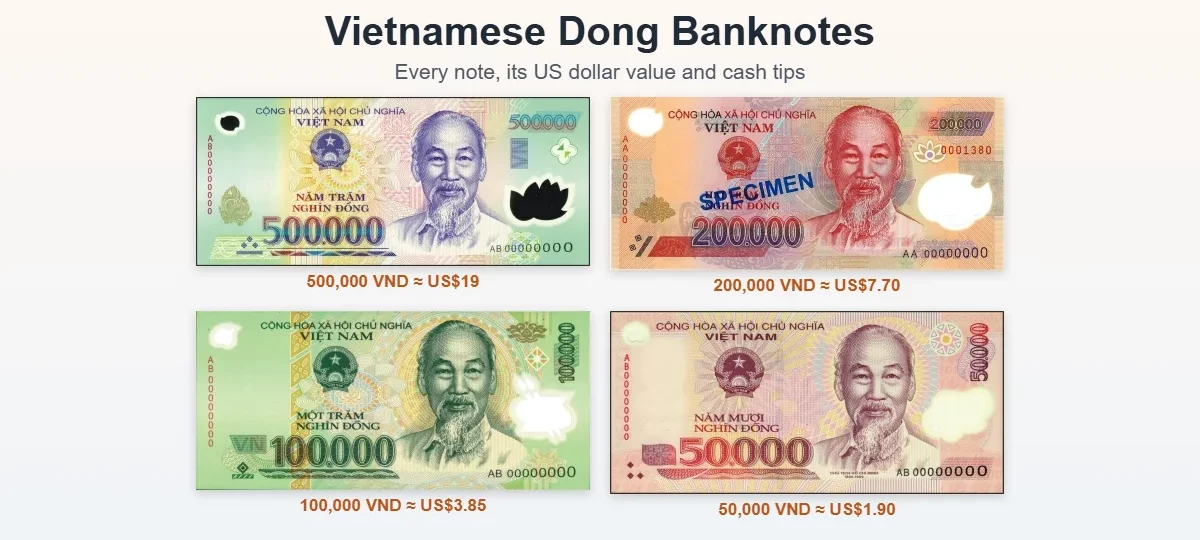
Vietnam uses nine banknotes in daily life: 500,000, 200,000, 100,000, 50,000, 20,000 and 10,000 dong in plastic (polymer), plus 5,000, 2,000 and 1,000 dong in paper. Coins are no longer used. At about 26,000 VND to US$1, the biggest note is worth around US$19 and the smallest about 4 US cents – so a quick glance at the zeros before you pay or tip saves you money and embarrassment. This guide shows every note front and back, its value in US dollars, the pairs travellers mix up, and which note to use for tips, taxis and street food.
Last updated: 9 November 2026 · Written by Jimmy, Vietnam Tour Expert
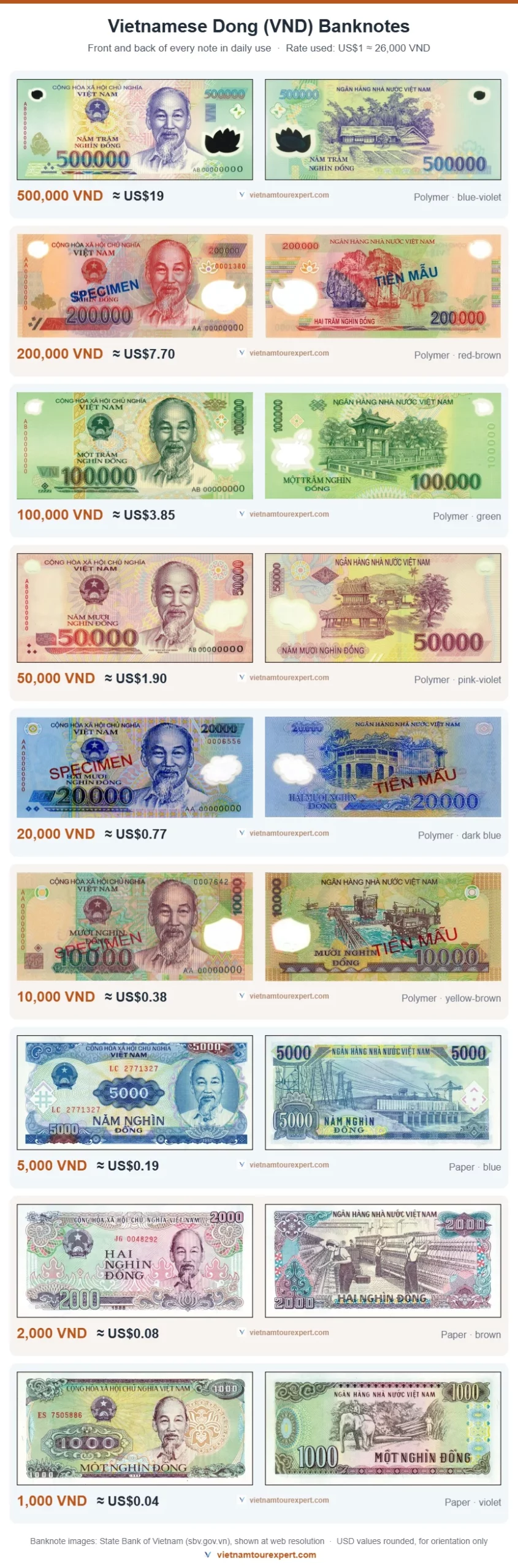
- Rule of thumb: 100,000 VND ≈ US$4 (exactly US$3.85). Drop three zeros, then divide by 26 – or simply think “25k is a dollar”.
- Most confused: the blue 20,000 and the blue 500,000; the reddish 10,000 and 200,000. Count the zeros every time.
- For tips: use 50,000, 100,000 or 200,000 notes. A 1,000–5,000 note is worth 4–19 US cents – not a tip.
- Carry small notes: street vendors and Grab bike drivers often cannot break a 500,000.
Vietnamese Dong Banknotes at a Glance
Every note shows President Ho Chi Minh on the front, so the portrait will not help you tell them apart – the colour, size and number of zeros will. Polymer notes get slightly longer as the value rises (the 500,000 is the longest at 152 mm).
| Note (VND) | ≈ US dollars | Material & colour | Picture on the back | Best used for |
|---|---|---|---|---|
| 500,000 | US$19 | Polymer, blue–violet, 152 × 65 mm | Ho Chi Minh’s childhood house, Kim Lien (Nghe An) | Hotels, tours, restaurants, shops with change |
| 200,000 | US$7.70 | Polymer, red–brown, 148 × 65 mm | Dinh Huong (Incense Burner) islet, Ha Long Bay | Restaurant bills, taxis, tipping guides |
| 100,000 | US$3.85 | Polymer, green, 144 × 65 mm | Khue Van Cac, Temple of Literature (Hanoi) | Meals, Grab cars, tips for drivers |
| 50,000 | US$1.90 | Polymer, pink–violet, 140 × 65 mm | Nghenh Luong Dinh pavilion, Hue | Pho, coffee, porters and housekeeping tips |
| 20,000 | US$0.77 | Polymer, dark blue, 136 × 65 mm | Japanese Covered Bridge, Hoi An | Banh mi, water, short bike rides, parking |
| 10,000 | US$0.38 | Polymer, yellow–brown, 132 × 60 mm | Bach Ho offshore oil field | Iced tea, motorbike parking, small change |
| 5,000 | US$0.19 | Paper, blue, 134 × 64 mm | Tri An hydropower plant | Change only (public toilets, iced tea) |
| 2,000 | US$0.08 | Paper, brown, 134 × 64 mm | Textile weaving workshop | Change only |
| 1,000 | US$0.04 | Paper, violet, 134 × 65 mm | Elephants hauling timber in the Central Highlands | Change only |
USD values use a round rate of 26,000 VND = US$1 and are for quick orientation; the real rate moves daily. For ATMs, cards, exchange and QR payments, see our full guide to money in Vietnam.
The Easy Way to Convert Dong to Dollars in Your Head
The zeros are what confuse first-time visitors. Use one of these shortcuts and you will never be out by a factor of ten:
- The “25k = US$1” shortcut: 25,000 VND is just under US$1, so 50,000 ≈ US$2, 100,000 ≈ US$4, 200,000 ≈ US$8 and 500,000 ≈ US$19–20.
- Drop three zeros: locals write and say prices in thousands. “50k”, “50 nghìn” or “50” on a menu all mean 50,000 VND.
- Dots, not commas: Vietnam writes 50.000đ or 50.000 VND – the dot separates thousands, it is not a decimal point.
- Check on your phone: type the price into your calculator and divide by 26,000 before paying anything large.
| You see | It means | ≈ US$ | Typical example |
|---|---|---|---|
| 10k | 10,000 VND | 0.40 | Iced tea (tra da) or motorbike parking |
| 30k | 30,000 VND | 1.15 | Banh mi from a street cart |
| 60k | 60,000 VND | 2.30 | Bowl of pho in Hanoi |
| 150k | 150,000 VND | 5.80 | Sit-down dinner for one at a local restaurant |
| 1tr / 1M | 1,000,000 VND | 38.50 | “tr” = triệu (million); common for hotel and tour prices |
Street prices vary by city and season; the examples are typical 2026 prices in Hanoi and Ho Chi Minh City.
The Notes Travellers Mix Up Most
Polymer notes are bright and similar in style, and in a dark taxi or a busy market it is easy to grab the wrong one. These are the pairs that cost visitors the most:
| Look-alike pair | Why they get confused | Cost of a mistake | How to tell them apart |
|---|---|---|---|
| 20,000 vs 500,000 | Both blue polymer | 480,000 VND (≈ US$18) | The 500,000 is longer (152 vs 136 mm), more violet, and has five zeros. The 20,000 back shows a small covered bridge. |
| 10,000 vs 200,000 | Both warm brown–red tones | 190,000 VND (≈ US$7.30) | The 10,000 is shorter (60 mm tall) with a yellow-green background; the 200,000 is clearly red and shows Ha Long Bay. |
| 5,000 vs 20,000 | Both blue | 15,000 VND (≈ US$0.60) | The 5,000 is soft paper; the 20,000 is smooth plastic with a clear window. |
| 50,000 vs 500,000 | Similar numbers when counted quickly | 450,000 VND (≈ US$17) | 50,000 is pink; 500,000 is blue. Read the digits, not just the colour. |
Tipping in Vietnam: Use the Right Note
Tipping is not a Vietnamese tradition and is never compulsory, but it is warmly appreciated in tourism. The most common mistake we see is a guest who means to tip well but hands over a 5,000 or 2,000 note – about 19 or 8 US cents – thinking it is 50,000 or 200,000. To a guide or driver who has worked a long day, that reads as a token rather than a thank-you. These are fair amounts, already converted into notes:
| Who | Suggested tip | Notes to use |
|---|---|---|
| Private tour guide | About US$5–10 per guest per day | 150,000–250,000 VND per guest per day, e.g. one 200,000 or a 100,000 + 50,000 |
| Private driver | About US$3–10 per day | 100,000–250,000 VND per day for the group |
| Hotel porter | US$1–2 | 20,000–50,000 VND per bag |
| Housekeeping | US$1–2 per day | 20,000–50,000 VND left daily |
| Spa or massage | 5–10% of the bill | 50,000 VND on a 500,000 VND massage |
| Grab, taxi, cyclo | Round up | Leave the change, or tip in the Grab app |
| Restaurants | Not expected | 5–10% in upscale places without a service charge |
- Never tip with 1,000, 2,000 or 5,000 notes – keep those for change.
- Tip in dong, not coins or foreign coins: coins cannot be exchanged by banks.
- Hand it over discreetly, folded, with both hands or the right hand, and a simple “cảm ơn” (thank you).
- Prepare tips the night before in an envelope, in good light, so you do not mix up blue or red notes in a hurry.
Every Vietnamese Banknote in Detail
Below is each note from the largest to the smallest, with how to recognise it, what it is worth and what it buys on the street. All six polymer notes were introduced between 2003 and 2006 by the State Bank of Vietnam and remain the standard design today.
500,000 VND – the biggest note (≈ US$19)
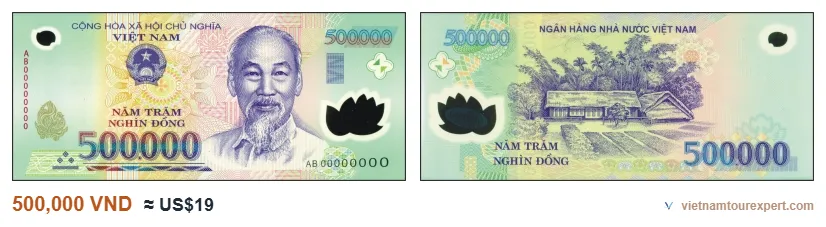
The back shows the thatched house in Kim Lien village, Nghe An, where Ho Chi Minh spent his childhood. This is the note ATMs dispense most, so you will often have a wallet full of them. It is perfect for hotels, tour payments, supermarkets and restaurant bills, but many street stalls, small cafés and Grab bike drivers cannot change it – break it at a convenience store (Circle K, WinMart+, FamilyMart), your hotel or a supermarket first. Because it is blue like the 20,000, always check the number of zeros before handing it over.
200,000 VND – the Ha Long Bay note (≈ US$7.70)
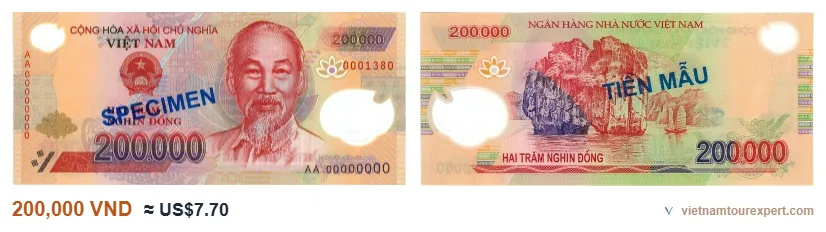
The back shows Hon Dinh Huong, the Incense Burner islet in Ha Long Bay – a fun one to compare with the real view on a Ha Long Bay cruise. It is the most useful note for paying a restaurant bill for two, a longer taxi ride, or as a tip for a private guide at the end of the day. Its red tone resembles the 10,000, so look for the larger size and the bay scene.
100,000 VND – the Temple of Literature note (≈ US$3.85)
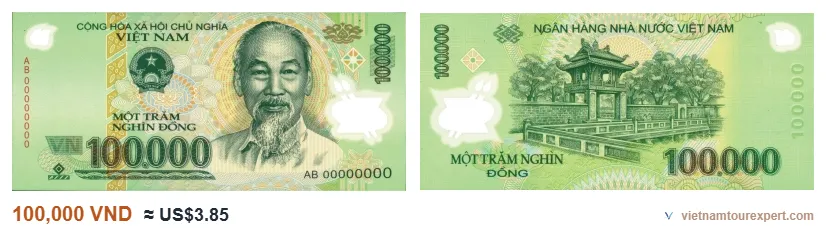
The back features Khue Van Cac, the Constellation of Literature pavilion at the Temple of Literature in Hanoi, Vietnam’s first national university. Think of it as “about four dollars”: enough for a Grab car across town, a local lunch with drinks or a museum ticket in many cities. It is a good everyday note to keep a few of, and a sensible tip for a driver or a group guide.
50,000 VND – the Hue note (≈ US$1.90)
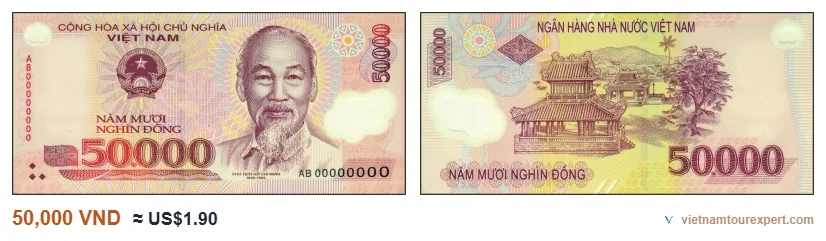
The back shows Nghenh Luong Dinh, the royal pavilion on the Perfume River in Hue. This is the street-food workhorse: a bowl of pho, a coffee, a fruit shake or a short Grab bike ride. It is also the ideal note for porters, housekeeping and small thank-yous – so ask for some 50,000 notes when you break a 500,000.
20,000 VND – the Hoi An note (≈ US$0.77)
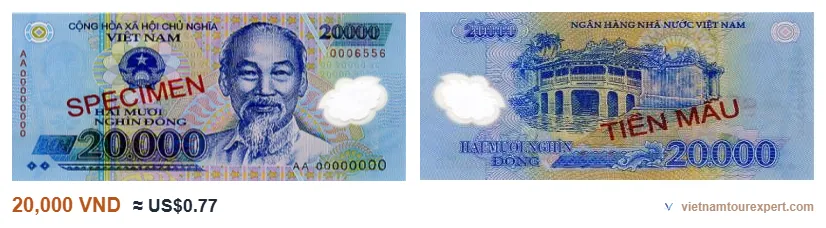
The back shows the 400-year-old Japanese Covered Bridge in Hoi An. It buys a bottle of water, a banh mi or parking for a motorbike. It is the note most often confused with the 500,000: both are blue, but the 20,000 is clearly shorter and darker. If someone tells you that you paid with a 20,000 when you believe you used a 500,000, stay calm and count together.
10,000 VND – the smallest polymer note (≈ US$0.38)
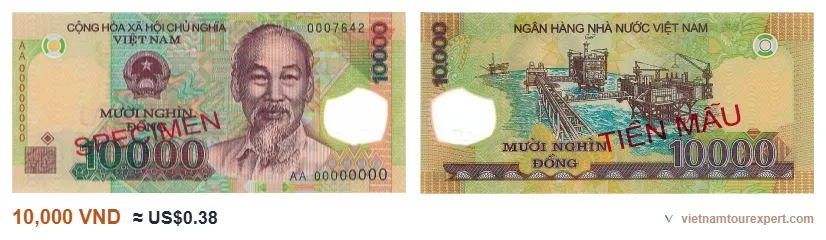
The back shows the Bach Ho (White Tiger) offshore oil field. It is the only polymer note that is noticeably narrower. Use it for iced tea, parking, public toilets and rounding up a taxi fare. Its brown-red tones can look like the 200,000 under warm lights.
5,000 VND – paper, change only (≈ US$0.19)
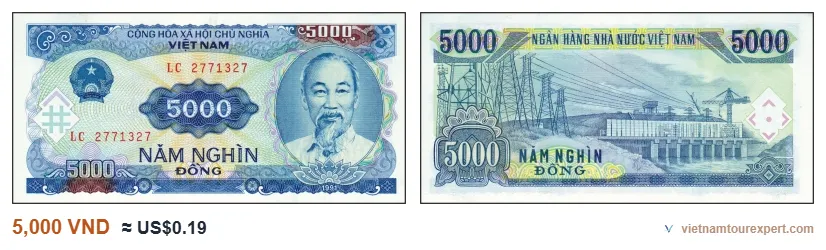
A soft cotton-paper note with the Tri An hydropower plant on the back. You will receive it as change at markets and convenience stores. Spend it on small items – never use it as a tip.
2,000 VND – paper, change only (≈ US$0.08)
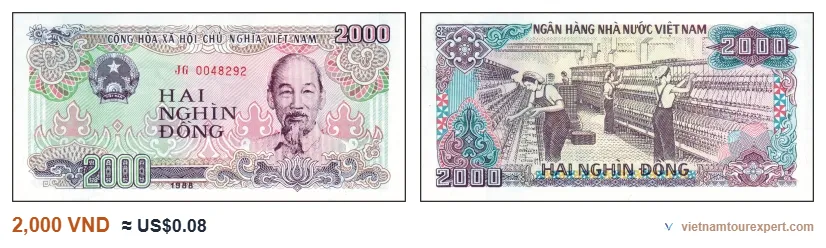
The back shows workers at a textile weaving workshop. Worth less than ten US cents, it mainly turns up as change from supermarkets or as part of a parking fee.
1,000 VND – the smallest note in use (≈ US$0.04)
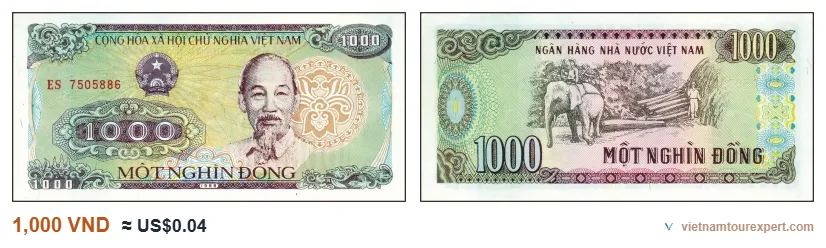
The back shows elephants hauling timber in the Central Highlands. Many shops round prices to the nearest 1,000 or simply give you a sweet instead of very small change. Keep a few for exact change, but do not be surprised if you rarely see one.
Old Notes and Coins You Might See
- 500, 200 and 100 VND paper notes: still legal but almost never used; you may be handed one as a souvenir.
- Coins (200 to 5,000 VND): introduced in 2003; the State Bank stopped minting them in 2011. They remain legal tender but most shops no longer accept them, so do not bring or collect them for spending.
- Older cotton notes of 10,000 to 500,000 VND were replaced by polymer and are no longer in circulation – if someone offers you one as payment, politely refuse.
How to Check a Note Is Genuine
Counterfeits are not common in tourist areas, but large polymer notes are the ones worth checking, especially when you receive change at night:
- Feel: genuine notes have raised printing on the portrait and the denomination that you can feel with a fingertip.
- Look through: polymer notes have a clear window; on genuine notes it is part of the note, not a hole covered with film.
- Tilt: on the large notes, the colour-shifting ink patch changes colour as you tilt the note.
- Check the watermark: hold it to the light and you should see Ho Chi Minh’s portrait as a watermark.
Shops may refuse badly torn notes or notes with writing on them, so do the same and ask for a different note when you receive change.
Practical Cash Tips from Our Guides
- Carry a mix: one or two 500,000s for big payments, several 100,000 and 50,000 notes for meals and tips, and a few 10,000–20,000 notes for snacks and parking.
- Use two pockets: large notes in a zipped wallet, small notes in an easy pocket so you never flash your whole wallet at a street stall.
- Break big notes early: pay with a 500,000 at a convenience store or supermarket, where change is never a problem.
- Polymer sticks together: new notes can cling – fan them out before paying so you do not hand over two.
- Count your change before you walk away, especially when several notes of similar colour are involved.
- Declaring cash: you must declare more than US$5,000 (or equivalent) in foreign currency, or more than 15,000,000 VND in cash, when entering or leaving Vietnam.
- Stay connected: a local data plan makes the Grab app and currency converters easy – see our Vietnam SIM card and eSIM guide.
Planning your first trip? Our Vietnam travel tips cover everything else to know before you go.
Local Expert Tips by Jimmy
- When you withdraw from an ATM, you will mostly get 500,000 notes. On day one, buy water at a convenience store to get 50,000 and 100,000 notes in change.
- On our private tours, guests often ask how much to tip. A 200,000 note per guest per day for a guide you enjoyed, and 100,000 for the driver, is a generous, well-received thank-you.
- Take a photo of the banknote chart above on your phone: it is the fastest way to check a note in a dark taxi.
Frequently Asked Questions about Vietnamese Banknotes
1. What banknotes are used in Vietnam?
Nine notes are in everyday use: 500,000, 200,000, 100,000, 50,000, 20,000 and 10,000 VND in polymer, and 5,000, 2,000 and 1,000 VND in paper. Coins are rarely accepted.
2. What is the largest Vietnamese banknote worth?
The 500,000 VND note is the largest. At about 26,000 VND per US dollar it is worth roughly US$19.
3. Which Vietnamese notes look alike?
The blue 20,000 and 500,000 notes are the most often confused, followed by the reddish 10,000 and 200,000. Check the number of zeros and the size: higher values are longer.
4. How do I convert Vietnamese dong to US dollars quickly?
Remember that 25,000 VND is just under US$1. So 100,000 VND is about US$4 and 500,000 VND about US$19–20. For accuracy, divide the price by 26,000.
5. Does Vietnam use coins?
Coins of 200 to 5,000 VND were issued in 2003, but minting stopped in 2011. They are still legal tender, yet most shops no longer accept them.
6. Are the 100, 200 and 500 dong notes still valid?
Yes, they are still legal tender, but they are almost never used because prices are rounded to the nearest 1,000 VND.
7. Which note should I use for tipping in Vietnam?
Use 50,000 VND for porters and housekeeping, and 100,000–200,000 VND for drivers and guides. Avoid tipping with 1,000–5,000 VND notes, which are worth only a few US cents.
8. Can I pay with torn or damaged notes?
Shops often refuse notes that are badly torn or written on. Ask for a different note if you receive one in your change.
9. Should I bring US dollars or Vietnamese dong?
Pay in Vietnamese dong for almost everything. Bring some US dollars as a backup to exchange at banks, and use ATMs or cards for the rest – see our money in Vietnam guide.
10. How much cash can I bring into Vietnam without declaring it?
You can bring up to US$5,000 (or equivalent) in foreign currency and up to 15,000,000 VND in cash without declaring. Above these amounts you must declare it at customs.
Banknote images: State Bank of Vietnam (sbv.gov.vn), reproduced at web resolution for traveller information. Exchange values use a fixed rate of 26,000 VND = US$1 for easy reading.
Related Posts
Vietnam Travel Tips 2026: 20 Things to Know Before You Go
Vietnam Packing List 2026: What to Wear & What to Bring by Season

Vietnam Etiquette 2026: Do’s and Don’ts for Travellers
Vietnam SIM Card & eSIM 2026: Best Travel SIM, Data Plans & Prices

Vietnam Scams 2026: 10 Common Tourist Scams & How to Avoid Them