Khai Dinh Tomb Hue: Ticket, History & Mosaic Palace
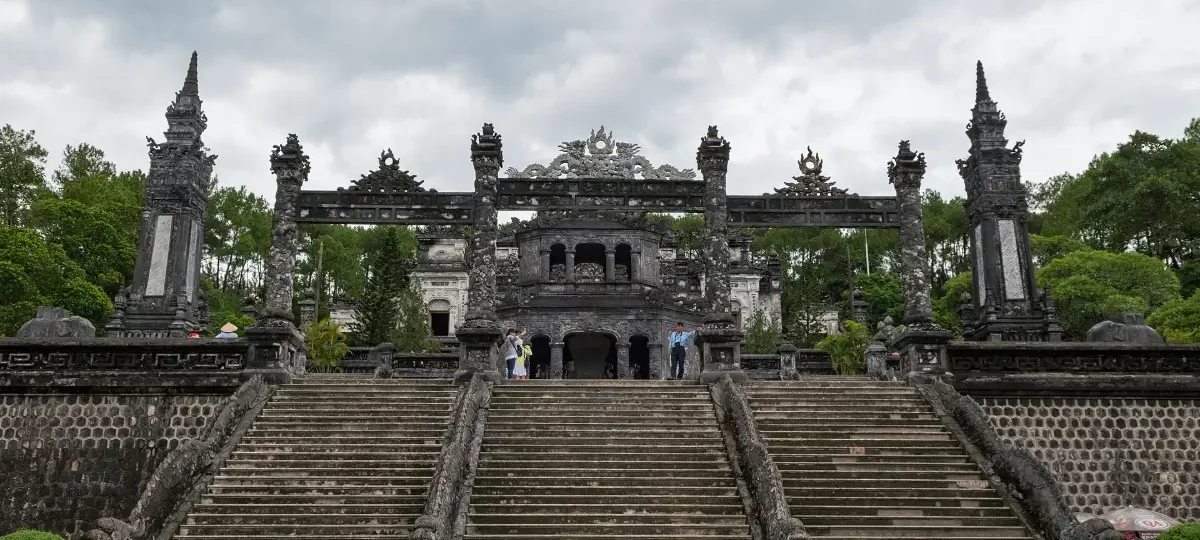
Khai Dinh Tomb (Lăng Khải Định, officially Ung Lang) is the hillside mausoleum of Emperor Khai Dinh, the 12th Nguyen ruler, about 10 km south of central Hue. Built from 1920 to 1931 in concrete, iron and slate, it blends Vietnamese, French and other influences and hides a dazzling glass-and-porcelain mosaic interior. Entry costs 150,000 VND for adults.
Status (checked October 2026): open daily as normal. Winter hours apply from 16 October (tickets 7:00–17:00, site closes 18:00); the 127 steps can be slippery in the October–December rains, so wear shoes with grip.
Why Khai Dinh Tomb is worth seeing:
- Unlike any other royal tomb: a dramatic East-meets-West design with Gothic, Baroque and Hindu-Buddhist touches.
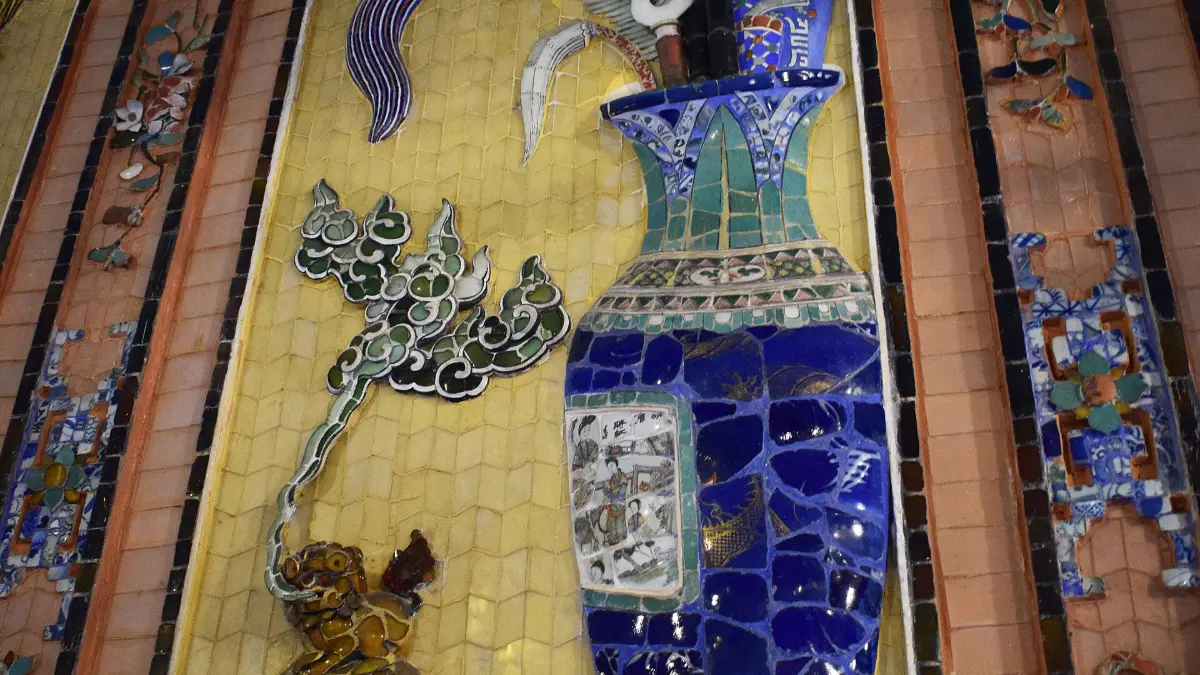
- The mosaic palace: Thien Dinh Palace is covered inside with pieces of glass, porcelain and ceramics.
- Bronze statue of the emperor: a bronze statue cast in France presides over his grave.
- Mountain views: the terraces look out over the pine-clad hills south of Hue.
- Compact and quick: you can see it properly in about an hour.
Khai Dinh Tomb at a Glance
| Vietnamese name | Lăng Khải Định (Ứng Lăng) |
|---|---|
| Location | Chau Chu Mountain (Ung Son), Thuy Xuan Ward (formerly Thuy Bang), Hue City |
| Distance | About 10 km south of central Hue; 20–25 minutes by car |
| Built | 4 September 1920 to 1931 (11 years), completed under Emperor Bao Dai |
| Size | Rectangular plan of about 117 m × 48.5 m, on 7 levels with 127 steps |
| Known for | Western-influenced architecture, Thien Dinh Palace mosaics, “nine dragons” ceiling, bronze statue |
| Recognition | Part of the UNESCO-listed Complex of Hue Monuments (1993) |
| Opening hours | Summer (16 Mar–15 Oct): tickets 6:30–17:30, closes 18:30. Winter (16 Oct–15 Mar): tickets 7:00–17:00, closes 18:00 |
| Entrance fee | 150,000 VND adults (about US$6); 30,000 VND children aged 7–12 |
| Time needed | 45–75 minutes |
| Best time | Early morning or late afternoon, February–April |
| Nearby | Tu Duc Tomb, Thuy Xuan Incense Village, Minh Mang Tomb, Dong Khanh Tomb |
| Find it | Google Maps · Tripadvisor · Official website · UNESCO |
Is Khai Dinh Tomb Worth Visiting?
Yes, especially if you enjoy decorative art and unusual architecture. Khai Dinh Tomb is the smallest of the three great royal tombs, yet the most ornate. It lacks the lakes and gardens of Tu Duc Tomb or Minh Mang Tomb, but its mosaic interior is unique in Vietnam and it photographs beautifully against the hills.
- Best for: photographers, architecture and art lovers, and travellers short on time.
- Skip if: you have limited mobility; the 127 steps have no lift or ramp.
- Short on time? Combine it with Tu Duc Tomb and the incense village in a half-day loop south of Hue.
History of Khai Dinh Tomb
An emperor close to France
Khai Dinh (1885–1925) came to the throne in 1916, aged 31, after the French exiled his predecessor, Emperor Duy Tan. He worked closely with the colonial authorities and visited France in 1922, and his tomb reflects his fascination with European style. He was unpopular with many Vietnamese, and his mausoleum is often criticised as a symbol of extravagance in a time of hardship.
Eleven years of building
Construction began on 4 September 1920 under the direction of Le Van Ba. To pay for it, Khai Dinh asked the protectorate government to allow a 30% rise in the land tax across the country, a decision Vietnamese historians have strongly condemned (some Western historians note that the French were already raising taxes for other reasons). Iron, steel, cement and slate tiles were imported from France, and porcelain and coloured glass from China and Japan. The emperor died in 1925, before the work was finished; his son, Emperor Bao Dai, completed the tomb in 1931.
A tomb apart
All earlier Nguyen tombs were built in wood, brick and stone, laid out across wide landscapes. Khai Dinh’s is compact, vertical and made largely of reinforced concrete, giving it its grey, weathered look. UNESCO listed the Tomb of Khai Dinh in 1993 as part of the Complex of Hue Monuments.
What to See at Khai Dinh Tomb
1. The dragon staircase
From the road, 37 steps flanked by dragon balustrades lead to the first courtyard. These steep stairs are the classic first photo of the tomb.
2. The Salutation Court and stone mandarins
On the second level, two rows of stone mandarins, soldiers, elephants and horses guard the path. Unlike the single rows at older tombs, they stand in double rows because the site is so compact, and the carving is noticeably more detailed.
3. The octagonal Stele Pavilion
The reinforced-concrete Stele Pavilion holds a stone stele carved with a biography of Khai Dinh in classical Chinese, attributed to Bao Dai. Octagonal rather than square, it differs from every other Nguyen stele house. Tall obelisk-like pillars topped with stupa forms stand on either side.
4. Thien Dinh Palace
At the highest level, Thien Dinh Palace is the heart of the tomb. Its grey façade, with arched entrances and carved symbols of longevity, gives no hint of the interior, which is an explosion of colour: walls and ceilings covered in mosaics of broken porcelain, glass and ceramics showing flowers, fruit, landscapes and the “four seasons”.
5. The “nine dragons in clouds” ceilings
Look up in the three central halls. Master artisan Phan Van Tanh created the ceiling paintings of nine dragons hiding in clouds, often cited as among the largest and finest murals of their kind in Vietnam.
6. The bronze statue and tomb chamber
Behind the central Khai Thanh altar hall, the innermost chamber holds the emperor’s grave, an altar and a bronze statue of Khai Dinh seated in imperial robes beneath an elaborate canopy; the statue was cast in Marseille. A side hall displays his personal belongings, photographs and a standing bronze statue.
7. The view from the top terrace
Before leaving, turn around at the top. The terraces look out across the valley towards the hills, and in the late afternoon the grey concrete takes on a warm glow.
Khai Dinh Tomb Tickets and Opening Hours (2026)
| Ticket | Adult | Child (7–12) |
|---|---|---|
| Khai Dinh Tomb only | 150,000 VND (about US$6) | 30,000 VND |
| 3 sites: Imperial City + Khai Dinh + Minh Mang or Tu Duc | 420,000 VND (about US$16) | 80,000 VND |
| 4 sites: Imperial City + Minh Mang + Tu Duc + Khai Dinh | 530,000 VND (about US$20) | 100,000 VND |
| All heritage sites combo | 600,000 VND (about US$23) | 120,000 VND |
| Hours, 16 March–15 October | Tickets 6:30–17:30; site closes 18:30 | |
| Hours, 16 October–15 March | Tickets 7:00–17:00; site closes 18:00 | |
Prices are set by the Hue City People’s Council and collected by the Hue Monuments Conservation Centre; check the official ticket page before you go. Children under 7 enter free.
Rules and Etiquette at Khai Dinh Tomb
- This is a royal tomb and a place of worship: cover shoulders and knees, and remove your hat inside Thien Dinh Palace.
- Do not touch the mosaics or lean on the walls; the decoration is fragile.
- Photography is generally allowed; do not climb on statues or balustrades.
- Smoking is not allowed anywhere on the site.
How to Get to Khai Dinh Tomb
| From | How | Time |
|---|---|---|
| Central Hue (south bank) | Taxi, Grab or private car | 20–25 min |
| Central Hue | Motorbike or bicycle (hilly final stretch) | 25 min by motorbike; about 45 min by bike |
| Tu Duc Tomb | Taxi or motorbike | About 15 min |
| Minh Mang Tomb | Taxi or motorbike | About 20–25 min |
| Phu Bai Airport | Taxi or private car | About 30 min |
Our Hue transport guide compares taxis, motorbike hire and private drivers for the tombs.
Best Time to Visit Khai Dinh Tomb
| When | What to expect |
|---|---|
| February–April | Pleasant temperatures for the climb and clear views |
| May–August | Hot; the stone terraces have little shade, so go early |
| September–December | Rainy season; mist on the hills can be atmospheric, but steps get slippery |
| Opening time | Quietest moment before tour groups arrive |
| Late afternoon | Warm light on the façade and the staircase |
Local Expert Tips for Khai Dinh Tomb
These tips come from years of arranging Hue tours for international travellers.
- Go first thing in the morning; by mid-morning tour buses fill the small courtyards.
- Take the 4-site combo ticket if you are also visiting the Hue Imperial City, Tu Duc and Minh Mang tombs.
- Bring a wide-angle lens or phone setting for the mosaic hall and ceilings.
- Stop at Thuy Xuan Incense Village on the way back; it is on the same road.
- Carry water; there are drinks stalls by the car park but none higher up.
Khai Dinh Tomb vs Tu Duc Tomb
| Khai Dinh Tomb | Tu Duc Tomb | |
|---|---|---|
| Style | Compact, vertical, concrete; East-West fusion | Spacious, traditional, set around a lake |
| Built | 1920–1931 | 1864–1867 |
| Highlight | Mosaic interior and bronze statue | Pavilions, pine forest and lotus lake |
| Walking | 127 steps | Mostly flat paths |
| Time needed | About 1 hour | 1–1.5 hours |
| Adult ticket | 150,000 VND | 150,000 VND |
Our view: see both if you can, because they show the two faces of the Nguyen dynasty. If you must choose, pick Khai Dinh for spectacle and Tu Duc for atmosphere.
Nearby Attractions
- Tu Duc Tomb: the poet-emperor’s lakeside retreat, closer to the city.
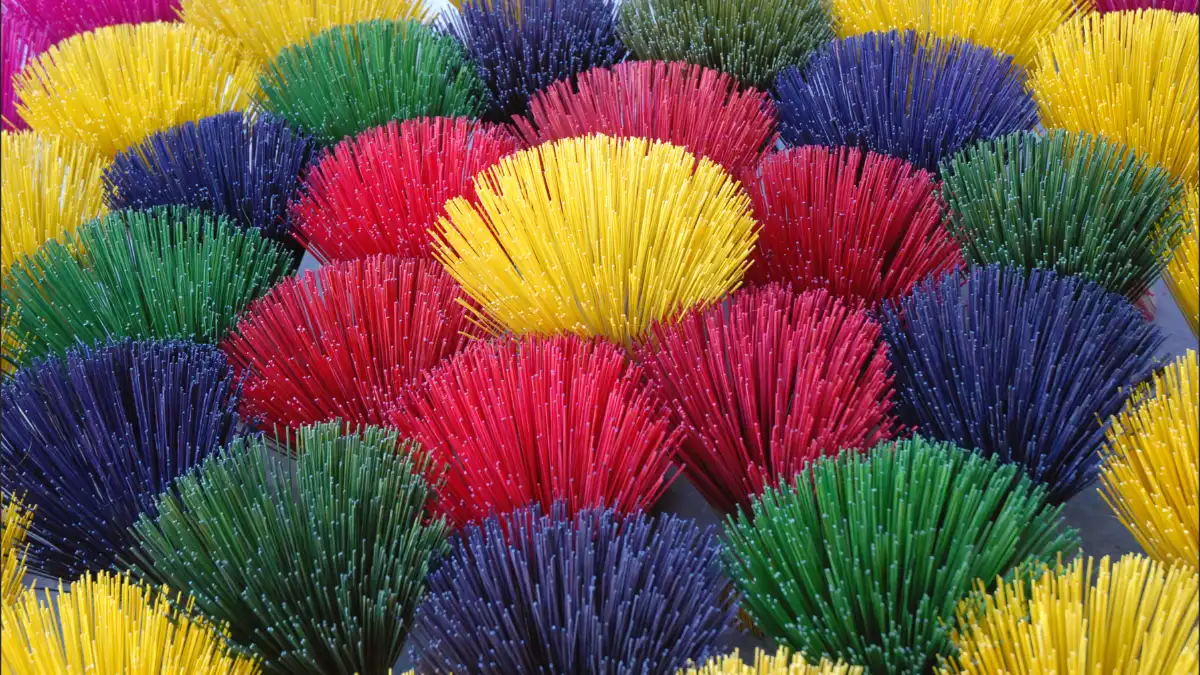
- Thuy Xuan Incense Village: colourful bundles of incense and conical hats.
- Minh Mang Tomb: the most harmonious of the royal tombs, further south on the Perfume River.
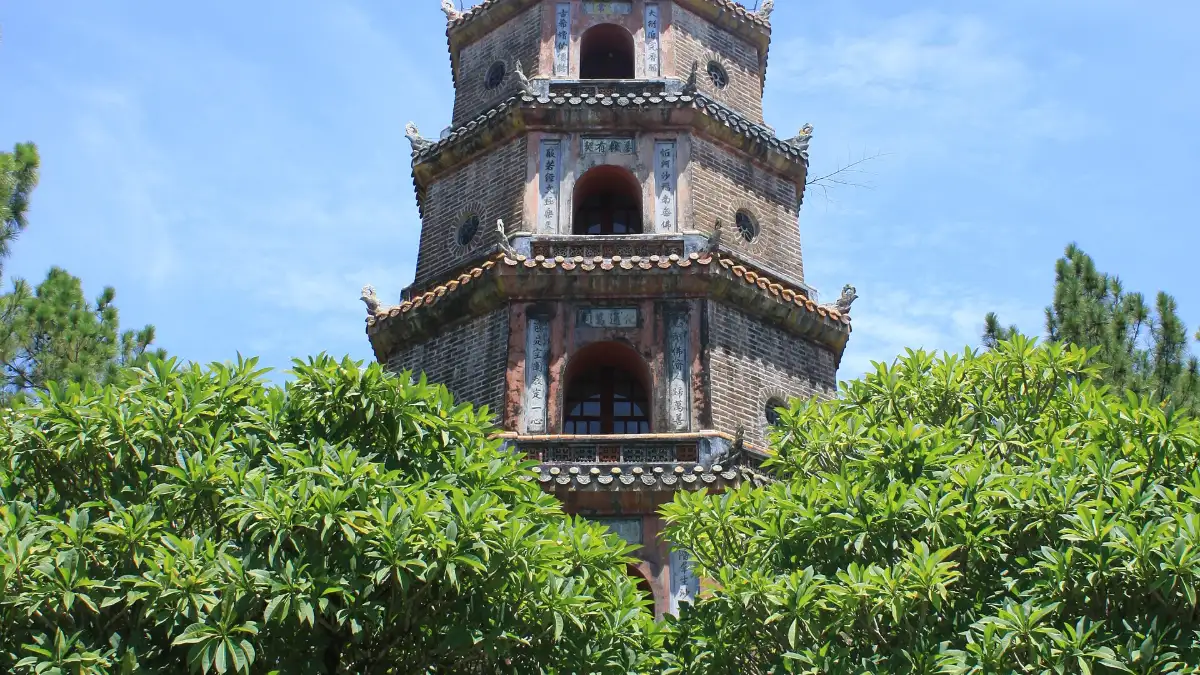
- Thien Mu Pagoda: Hue’s iconic pagoda, often combined with the tombs.
- Hue Imperial City: the palace of the Nguyen emperors.
Sightseeing in Hue for First-Time Visitors: Where Khai Dinh Tomb Fits
One day in Hue? Visit the Imperial City in the morning, then head south in the afternoon to Tu Duc Tomb, the incense village and Khai Dinh Tomb, finishing back in town for dinner. Our guide to Hue food suggests where to try bun bo Hue and royal-style dishes.
Two days? Add a Perfume River boat ride to Thien Mu Pagoda and Minh Mang Tomb. See our Hue hotel areas guide and practical Hue travel tips before you go.
Plan your trip with our Hue travel guide and Hue tours. Contact Vietnam Tour Expert Team for a free custom itinerary.
Frequently Asked Questions about Khai Dinh Tomb
1. Where is Khai Dinh Tomb?
Khai Dinh Tomb stands on Chau Chu Mountain in Thuy Xuan Ward, Hue City, about 10 km south of the city centre.
2. How much is the Khai Dinh Tomb ticket?
The Khai Dinh Tomb ticket costs 150,000 VND for adults and 30,000 VND for children aged 7–12; children under 7 are free.
3. What are the opening hours of Khai Dinh Tomb?
From 16 March to 15 October tickets are sold 6:30–17:30 (closing 18:30); from 16 October to 15 March tickets are sold 7:00–17:00 (closing 18:00).
4. Why is Khai Dinh Tomb famous?
Khai Dinh Tomb is famous for its unusual blend of Vietnamese and European architecture and for the glittering glass-and-porcelain mosaics inside Thien Dinh Palace.
5. How long does it take to visit Khai Dinh Tomb?
Most visitors spend 45 to 75 minutes at Khai Dinh Tomb, including the climb and time inside the palace.
6. How many steps are there at Khai Dinh Tomb?
Khai Dinh Tomb rises over seven levels with 127 steps in total, beginning with a steep 37-step dragon staircase.
7. When was Khai Dinh Tomb built?
Work started on 4 September 1920 and took 11 years; Khai Dinh Tomb was completed in 1931 under Emperor Bao Dai.
8. Is Khai Dinh Tomb worth visiting?
Yes. Khai Dinh Tomb is small, but its mosaic interior and dramatic hillside setting make it one of the most memorable sights in Hue.
9. Is there a combo ticket including Khai Dinh Tomb?
Yes. The 4-site combo (Imperial City, Minh Mang, Tu Duc and Khai Dinh) costs 530,000 VND for adults, and 3-site combos cost 420,000 VND.
10. Is Khai Dinh buried in the tomb?
Yes. Emperor Khai Dinh’s grave lies in the innermost chamber of Thien Dinh Palace, beneath his seated bronze statue.
11. Is there a dress code at Khai Dinh Tomb?
Modest clothing is expected at Khai Dinh Tomb: avoid very short shorts, short skirts and off-the-shoulder tops, and remove hats indoors.
12. How do I get to Khai Dinh Tomb from Hue?
The easiest way to reach Khai Dinh Tomb is by taxi, Grab or private car, taking 20–25 minutes from the centre; see our Hue transportation guide.
13. Is Khai Dinh Tomb suitable for elderly travellers?
Khai Dinh Tomb involves 127 steps with no lift, so travellers with limited mobility may find it tiring; take it slowly and rest on the terraces.
14. Which is better, Khai Dinh Tomb or Tu Duc Tomb?
Khai Dinh Tomb is more ornate and dramatic, while Tu Duc Tomb is larger, greener and more peaceful; many travellers visit both.
15. Can you take photos inside Khai Dinh Tomb?
Photography is generally allowed at Khai Dinh Tomb, including inside Thien Dinh Palace; be respectful around the altar.
16. What is the best time to visit Khai Dinh Tomb?
Visit Khai Dinh Tomb at opening time or in the late afternoon, ideally between February and April when the weather is mild.
17. What can I combine with Khai Dinh Tomb?
Khai Dinh Tomb pairs easily with Tu Duc Tomb, Minh Mang Tomb and Thuy Xuan Incense Village on a half-day loop.
Related Posts
Hue Travel Tips 2026: Best Time, Tickets & Dress Code

Where to Stay in Hue: Best Areas & Hotels by Budget

Hue Transportation: Airport, Trains, Hai Van Pass & Boats
Hue Food Guide: Bun Bo Hue, Royal Cuisine & Where to Eat

Lang Co Beach: Bay, Lagoon & Seafood Between Hue and Da Nang