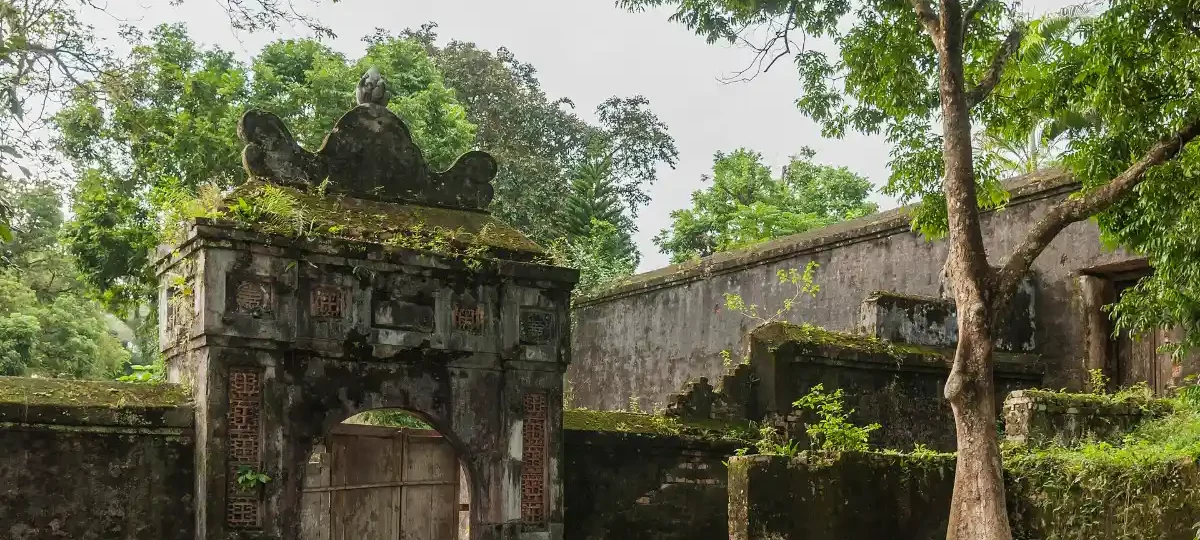
Tu Duc Tomb Hue: Ticket, History & Romantic Gardens
Tu Duc Tomb (Lăng Tự Đức, officially Khiem Lang) is the romantic lakeside mausoleum of Emperor Tu Duc, the longest-reigning Nguyen ruler, in a pine valley about 6 km south of central Hue. Built from 1864 to 1867, it served as his palace retreat for poetry and boating while he lived. Entry costs 150,000 VND for adults.
Status (checked October 2026): open daily as normal. Winter hours apply from 16 October (tickets 7:00–17:00, site closes 18:00); expect showers and some muddy paths from October to December.
Why Tu Duc Tomb is worth seeing:
- A tomb built for living: the emperor used it as a country palace long before his death.
- Lake, island and pavilions: Luu Khiem Lake and the wooden Xung Khiem Pavilion are among the loveliest scenes in Hue.
- One of Vietnam’s oldest theatres: Minh Khiem Duong was built for royal performances.
- A unique stele: Tu Duc wrote his own 4,935-character epitaph, carved on a 20-tonne stone.
- Close to town: the easiest of the great tombs to reach.
Tu Duc Tomb at a Glance
| Vietnamese name | Lăng Tự Đức (Khiêm Lăng; originally Khiêm Cung) |
|---|---|
| Location | Thuong Ba residential group, Thuy Xuan Ward, Hue City (old Duong Xuan Thuong village) |
| Distance | About 6 km south of central Hue; 15 minutes by car |
| Built | 1864–1867 |
| Size | Brick and stone wall over 1,800 m long; nearly 50 structures, all named with the word “Khiem” (modesty) |
| Known for | Luu Khiem Lake, Xung Khiem Pavilion, Hoa Khiem Temple, Minh Khiem theatre, the stele pavilion |
| Recognition | Part of the UNESCO-listed Complex of Hue Monuments (1993) |
| Opening hours | Summer (16 Mar–15 Oct): tickets 6:30–17:30, closes 18:30. Winter (16 Oct–15 Mar): tickets 7:00–17:00, closes 18:00 |
| Entrance fee | 150,000 VND adults (about US$6); 30,000 VND children aged 7–12 |
| Time needed | 1–1.5 hours |
| Best time | February–April; early morning or late afternoon |
| Nearby | Thuy Xuan Incense Village, Dong Khanh Tomb, Khai Dinh Tomb, Tu Hieu Pagoda |
| Find it | Google Maps · Tripadvisor · Official website · UNESCO |
Is Tu Duc Tomb Worth Visiting?
Yes. It is the most poetic of the Hue royal tombs and a highlight of any visit. Frangipani trees, pine-covered hills and a lotus-filled lake surround its weathered pavilions, creating an atmosphere quite different from the grand symmetry of Minh Mang Tomb or the concrete drama of Khai Dinh Tomb.
- Best for: romantics, photographers, garden lovers and anyone with only time for one tomb.
- Skip if: you want gleaming restored interiors; much of Tu Duc Tomb is mossy and atmospheric rather than polished.
- Short on time? Walk from the lake to Hoa Khiem Temple, then cross to the stele pavilion and the tomb: about 50 minutes.
History of Tu Duc Tomb
The poet-emperor
Tu Duc ruled from 1848 to 1883, the longest reign of any Nguyen emperor. A scholar and poet, he faced the French conquest of southern Vietnam during his reign. Although he had more than 100 wives and concubines, he had no children, possibly because of an illness in his youth, and adopted heirs instead.
“Ten Thousand Years” and the Chay Voi rebellion
Work on the complex began in 1864 and the main structures were finished in 1867. At first it was called Khiem Cung (Palace of Modesty); it became Khiem Lang (Tomb of Modesty) after the emperor’s death. The forced labour and harsh supervision were so severe that in 1866 workers joined the Chay Voi uprising, a failed attempt to overthrow the emperor. A popular verse of the time mocked the project, saying its walls were built with soldiers’ bones and its moat dug with people’s blood.
A tomb without the emperor?
Tu Duc spent long periods here, reading, writing poetry, fishing and watching performances. When he died in 1883, he was buried within the complex, but legend says his body was secretly laid elsewhere and that the location remains unknown. His adopted son, Emperor Kien Phuc, and Empress Le Thien Anh are also buried in the grounds. Learn more about the Tomb of Tu Duc and its legends.
What to See at Tu Duc Tomb
1. Luu Khiem Lake and Khiem Island
Just inside the gate, Luu Khiem Lake curves around the complex. On the small island in its centre, the emperor once kept rare animals and went hunting small game. Three bridges cross the water towards the pine hills.
2. Xung Khiem and Du Khiem pavilions
The wooden Xung Khiem Pavilion, built out over the water, was where Tu Duc composed poems and admired flowers with his court. Du Khiem Pavilion opposite served as the landing for royal boats. Together they form the classic postcard view of the tomb.
3. Khiem Cung Mon gate
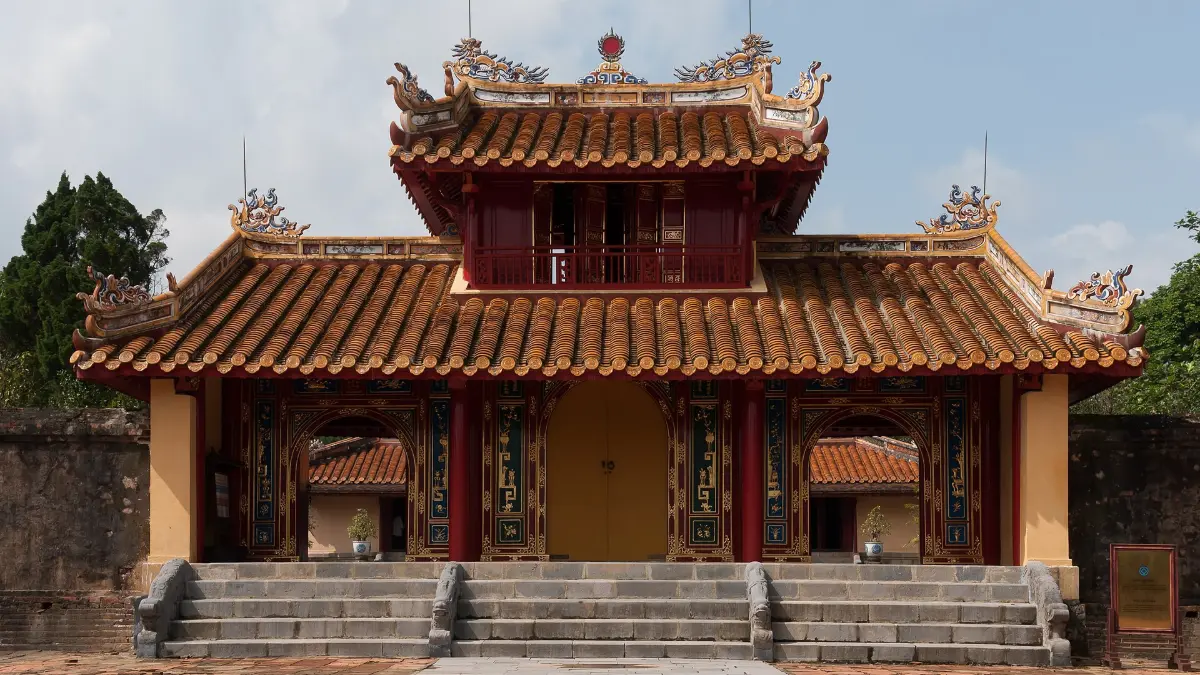
Three flights of stone steps lead to Khiem Cung Mon, the two-storey gate of the temple area. From its upper level the emperor could look out over the lake.
4. Hoa Khiem Temple
The emperor’s former office is now the temple honouring Tu Duc and his empress. Inside, look for the altars, lacquered panels and royal objects associated with the emperor and his family.
5. Minh Khiem Duong theatre
To the left of Luong Khiem Temple stands Minh Khiem Duong, a small wooden theatre built for the emperor’s entertainment. It is considered one of the oldest surviving theatres in Vietnam.
6. Luong Khiem Temple
Once the emperor’s resting place, Luong Khiem later became the temple of his mother, Queen Tu Du. Nearby, On Khiem Duong held his personal belongings.
7. The Salutation Court and Stele Pavilion
The tomb area lies on a separate axis. Rows of stone mandarins, elephants and horses lead to the Stele Pavilion, which shelters a 20-tonne Thanh Hoa stone stele carved in 1871 with “Khiem Cung Ky”. Because he had no son to write it, Tu Duc composed this 4,935-character text himself, describing his life, illnesses and mistakes.
8. The tomb enclosure
Beyond a crescent-shaped pond, the Buu Thanh wall surrounds the emperor’s stone sepulchre. Nearby you will find the separate tombs of Empress Le Thien Anh and Emperor Kien Phuc.
Tu Duc Tomb Tickets and Opening Hours (2026)
| Ticket | Adult | Child (7–12) |
|---|---|---|
| Tu Duc Tomb only | 150,000 VND (about US$6) | 30,000 VND |
| 2 sites: Tu Duc + Dong Khanh tombs | 200,000 VND (about US$8) | 30,000 VND |
| 3 sites: Imperial City + Tu Duc + Minh Mang or Khai Dinh | 420,000 VND (about US$16) | 80,000 VND |
| 4 sites: Imperial City + Minh Mang + Tu Duc + Khai Dinh | 530,000 VND (about US$20) | 100,000 VND |
| Hours, 16 March–15 October | Tickets 6:30–17:30; site closes 18:30 | |
| Hours, 16 October–15 March | Tickets 7:00–17:00; site closes 18:00 | |
Prices are set by the Hue City People’s Council and collected by the Hue Monuments Conservation Centre; check the official ticket page before you go. Children under 7 enter free.
Rules and Etiquette at Tu Duc Tomb
- Dress modestly and remove hats inside the temples.
- Do not sit or climb on the pavilion railings or statues; the woodwork is old and fragile.
- Keep off the lawns and do not pick flowers.
- Smoking is prohibited throughout the site.
How to Get to Tu Duc Tomb
| From | How | Time |
|---|---|---|
| Central Hue | Taxi, Grab or private car | About 15 min |
| Central Hue | Bicycle or motorbike | 15 min by motorbike; 30 min by bike |
| Thuy Xuan Incense Village | Short drive or ride | A few minutes |
| Khai Dinh Tomb | Taxi or motorbike | About 15 min |
| Hue Imperial City | Taxi or Grab | About 20 min |
Our Hue transportation guide explains taxis, private drivers and bike hire.
Best Time to Visit Tu Duc Tomb
| When | What to expect |
|---|---|
| February–April | Mild and green; the best months for walking the gardens |
| May–August | Hot; lotus on the lake in early summer; shade under the pines |
| September–December | Rainy season; moody, misty scenes but wet paths |
| Early morning | Still water and soft light at Xung Khiem Pavilion |
| Late afternoon | Golden light and fewer groups |
Local Expert Tips for Tu Duc Tomb
These tips come from years of arranging Hue tours for international travellers.
- Visit Tu Duc Tomb first or last in the day; it is closest to the city and easy to fit around other sights.
- Walk the loop clockwise from the lake to the temples and then the tomb, so you finish at the quieter end.
- Combine it with Dong Khanh Tomb on the 2-site ticket: Dong Khanh is small but has fine interior decoration.
- Stop at Thuy Xuan Incense Village on the way for colourful photos.
- Carry mosquito repellent in the wet season.
Tu Duc Tomb vs Minh Mang Tomb
| Tu Duc Tomb | Minh Mang Tomb | |
|---|---|---|
| Atmosphere | Romantic, intimate, garden-like | Majestic, formal, symmetrical |
| Built | 1864–1867 | 1840–1843 |
| Distance from centre | About 6 km | About 12 km |
| Highlight | Xung Khiem Pavilion on the lake | Minh Lau Pavilion and the long axis |
| Adult ticket | 150,000 VND | 150,000 VND |
Our view: if you can visit only one traditional tomb, Tu Duc is the easier and more atmospheric choice; Minh Mang rewards those with more time.
Nearby Attractions
- Thuy Xuan Incense Village: rainbow-coloured incense bundles a short ride away.
- Khai Dinh Tomb: the ornate hillside tomb further south.
- Minh Mang Tomb: the most harmonious tomb, by the Perfume River.
- Hue Imperial City: the Nguyen palace in the Citadel.
- Thien Mu Pagoda: Hue’s best-known pagoda.
Sightseeing in Hue for First-Time Visitors: Where Tu Duc Tomb Fits
One day in Hue? See the Imperial City in the morning, then spend the afternoon at Tu Duc Tomb, the incense village and Khai Dinh Tomb. In the evening, cross Truong Tien Bridge and try local dishes from our Hue food guide.
Two days? Add Minh Mang Tomb, a Perfume River boat ride and Thien Mu Pagoda. Read our Hue travel tips and choose the right area to stay.
Plan your trip with our Hue travel guide and Hue tours. Contact Vietnam Tour Expert Team for a free custom itinerary.
Frequently Asked Questions about Tu Duc Tomb
1. Where is Tu Duc Tomb?
Tu Duc Tomb is in Thuy Xuan Ward, Hue City, in a pine valley about 6 km south of the city centre.
2. How much is the Tu Duc Tomb ticket?
The Tu Duc Tomb ticket costs 150,000 VND for adults and 30,000 VND for children aged 7–12; children under 7 are free.
3. What are the opening hours of Tu Duc Tomb?
From 16 March to 15 October tickets are sold 6:30–17:30 (closing 18:30); from 16 October to 15 March, 7:00–17:00 (closing 18:00).
4. When was Tu Duc Tomb built?
The main structures of Tu Duc Tomb were built between 1864 and 1867, during the emperor’s lifetime.
5. Why is Tu Duc Tomb famous?
Tu Duc Tomb is famous for its romantic landscape of lakes, pavilions and pine hills, and for having been used as a palace retreat by the emperor while he lived.
6. Is Tu Duc buried in Tu Duc Tomb?
Officially he was buried in the tomb enclosure, but legend says his body was secretly buried elsewhere and the real location of Tu Duc’s grave is still unknown.
7. How long does it take to visit Tu Duc Tomb?
Most visitors spend 1 to 1.5 hours at Tu Duc Tomb.
8. Is Tu Duc Tomb worth visiting?
Yes. Tu Duc Tomb is one of the most beautiful and atmospheric sights in Hue and easy to reach from the city.
9. Is there a combo ticket for Tu Duc Tomb?
Yes. Tu Duc Tomb is included in the 3-site (420,000 VND) and 4-site (530,000 VND) tickets, and a 2-site ticket with Dong Khanh Tomb costs 200,000 VND.
10. How far is Tu Duc Tomb from the Imperial City?
Tu Duc Tomb is about 20 minutes by car from the Hue Imperial City.
11. What does “Khiem” mean at Tu Duc Tomb?
“Khiem” means modesty; almost every building at Tu Duc Tomb includes the word in its name, and the tomb itself is called Khiem Lang.
12. What was the Chay Voi rebellion at Tu Duc Tomb?
In 1866 workers forced to build Tu Duc Tomb joined the Chay Voi uprising against the emperor; it failed, but it shows how harsh the construction was.
13. Is there a dress code at Tu Duc Tomb?
Modest clothing is expected at Tu Duc Tomb, especially in the temples; remove hats indoors.
14. What is the best time to visit Tu Duc Tomb?
Early morning and late afternoon are best at Tu Duc Tomb, ideally between February and April.
15. Can I cycle to Tu Duc Tomb?
Yes. Tu Duc Tomb is about 30 minutes by bicycle from central Hue on fairly quiet roads.
16. Which is better, Tu Duc Tomb or Khai Dinh Tomb?
Tu Duc Tomb is greener and more peaceful, while Khai Dinh Tomb is more ornate; with time, visit both.
Related Posts
Hue Travel Tips 2026: Best Time, Tickets & Dress Code

Where to Stay in Hue: Best Areas & Hotels by Budget

Hue Transportation: Airport, Trains, Hai Van Pass & Boats

Hue Food Guide: Bun Bo Hue, Royal Cuisine & Where to Eat

Lang Co Beach: Bay, Lagoon & Seafood Between Hue and Da Nang