Tran Quoc Pagoda: Hanoi’s Oldest Pagoda on West Lake – Visitor Guide (2026)
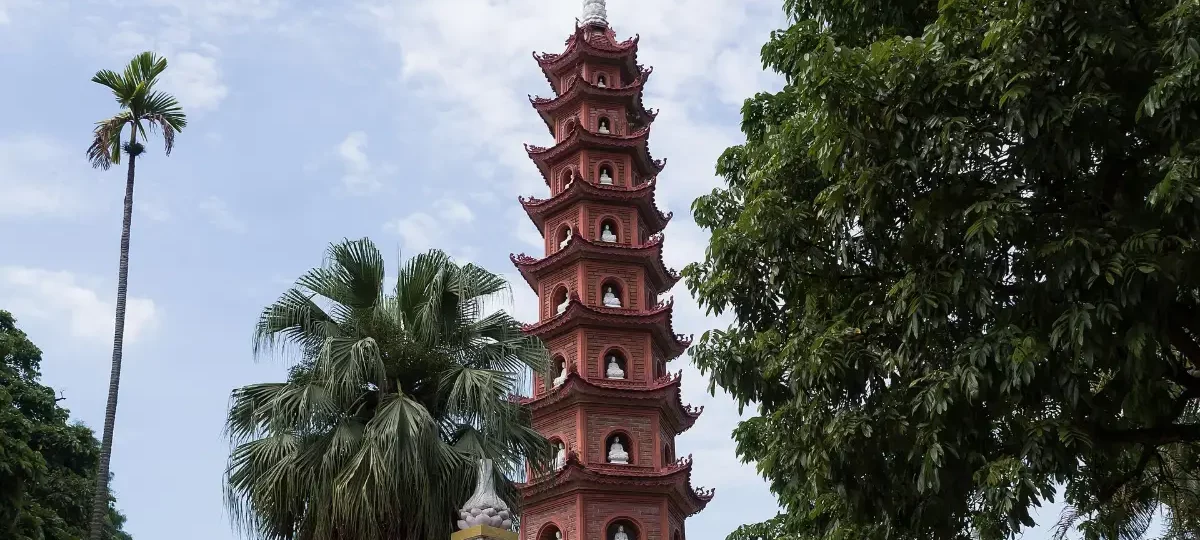
Tran Quoc Pagoda (Chùa Trấn Quốc) is Hanoi’s oldest Buddhist pagoda, founded in the 6th century and sitting on a small islet off the eastern shore of West Lake, about 3.5 km north of Hoan Kiem Lake. It is famous for its 15-metre, 11-storey red stupa and a Bodhi tree grown from the tree at Bodh Gaya. Entry is free.
Status (checked October 2026): open daily as normal, roughly 8:00–16:00, with free entry; hours are longer on the 1st and 15th days of the lunar month and around Tet, when the pagoda is very crowded with worshippers.
Why Tran Quoc Pagoda is worth seeing:
- Hanoi’s oldest pagoda: its story goes back about 1,500 years, to the reign of Ly Nam De (544–548).
- The lotus stupa: an 11-storey, 15-metre tower holding 66 gemstone statues of Amitabha Buddha.
- A living temple: monks, incense and local worshippers, not a museum piece.
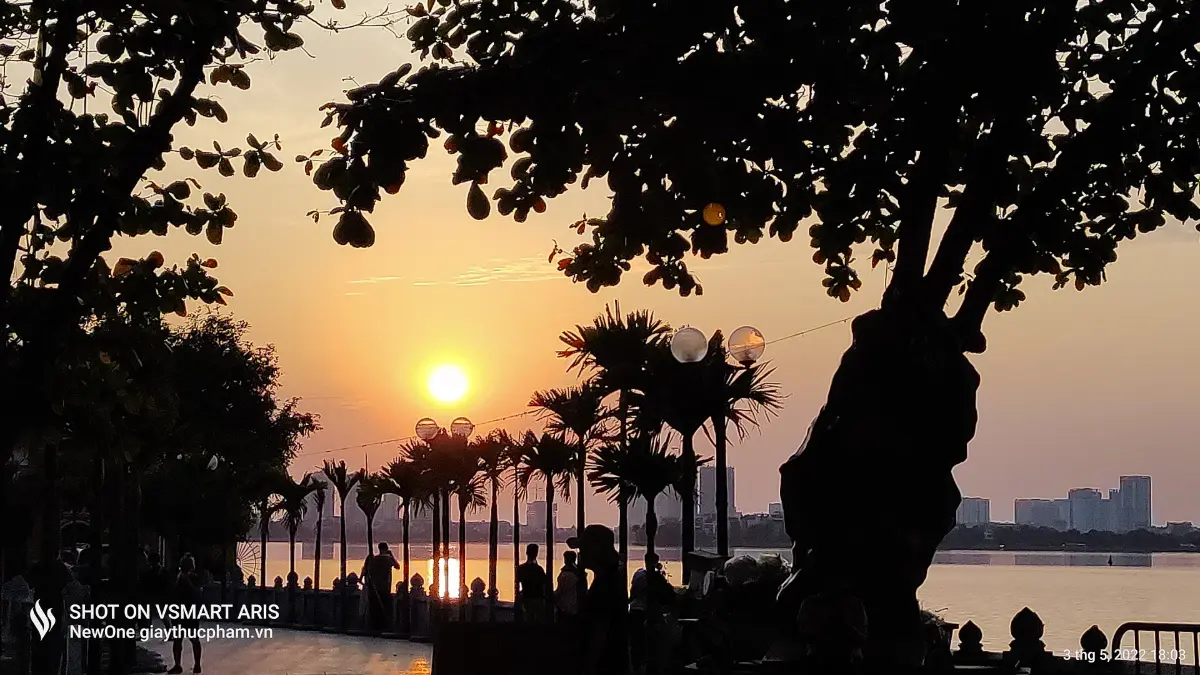
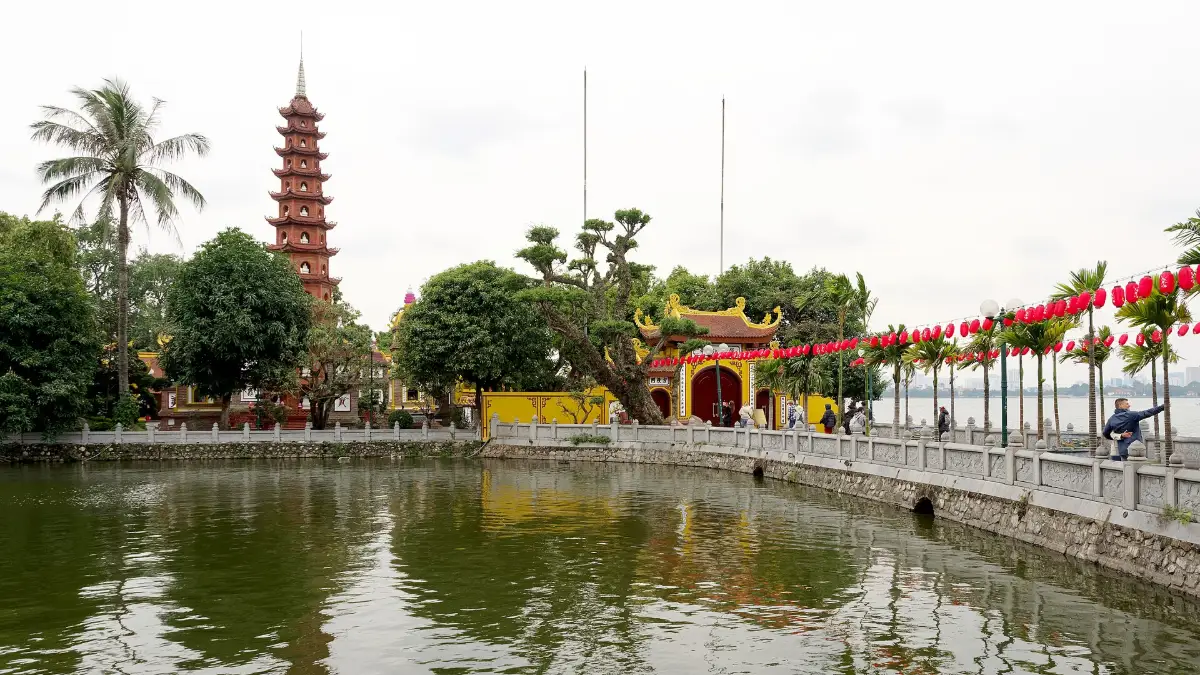
- The setting: an island on West Lake, linked by a short causeway, with sunset views over the water.
- Free and quick: 30–45 minutes is enough, and it fits easily into a morning around Ba Dinh.
Tran Quoc Pagoda at a Glance
| Vietnamese name | Chùa Trấn Quốc (Sino-Vietnamese 鎮國寺, “Pagoda Guarding the Nation”) |
|---|---|
| Location | 46 Thanh Nien Road, Tay Ho Ward, Hanoi, on an islet between West Lake and Truc Bach Lake |
| Distance | About 3.5 km from Hoan Kiem Lake (10–15 minutes by taxi); about 2 km from the Ho Chi Minh Mausoleum |
| Known for | Oldest pagoda in Hanoi, 11-storey lotus stupa, Bodhi tree gifted in 1959, West Lake sunsets |
| Recognition | National historical and cultural relic of Vietnam |
| Opening hours | Daily, about 8:00–16:00; longer on the 1st and 15th lunar days |
| Entrance fee | Free (donations welcome) |
| Time needed | 30–45 minutes; 1.5–2 hours with a West Lake walk |
| Best time | Early morning on a weekday, or late afternoon for sunset over West Lake |
| Nearby | West Lake, Truc Bach Lake, Quan Thanh Temple, Ho Chi Minh Mausoleum |
| Find it | Google Maps · Tripadvisor · Wikipedia |
Is Tran Quoc Pagoda Worth Visiting?
Yes, especially if you are already near West Lake or the Ho Chi Minh Mausoleum. It is small, free and photogenic, and it gives you a genuine look at Vietnamese Buddhism in daily use. Do not expect a huge complex: the whole island can be walked in a few minutes, and the interest lies in the stupa, the shrines and the lakeside atmosphere.
- Best for: first-time visitors, photographers, travellers interested in Buddhism and anyone combining it with a West Lake walk or the nearby Quan Thanh Temple.
- Skip if: you have already seen several large pagodas and only have a few hours in Hanoi; the Temple of Literature is the bigger historic site.
- Short on time: 30 minutes is enough: cross the causeway, circle the stupa, see the Bodhi tree and the main hall.
History of Tran Quoc Pagoda
Founded on the Red River (6th century)
The pagoda was founded in the mid-6th century, during the reign of Ly Nam De (544–548), the ruler of the short-lived Van Xuan state. It first stood on the bank of the Red River outside the Yen Phu dyke and was called Khai Quoc (“Founding the Nation”). That makes it the oldest Buddhist pagoda in Hanoi, older than the city of Thang Long itself, which dates from 1010.
Moved to the Golden Fish islet (1615)
In 1615, as the river bank eroded, the pagoda was moved to Kim Ngu (Golden Fish) islet in West Lake, where it stands today. A causeway was built to link it to the shore; it later became today’s Thanh Nien Road, which separates West Lake from Truc Bach Lake. In 1639 the pagoda was extended with new halls and corridors.
Many names, one pagoda
King Le Thai Tong renamed it An Quoc (“Pacifying the Nation”) in 1440. Under King Le Hy Tong (reigned 1675–1705) it became Tran Quoc (“Guarding the Nation”). In 1842 Emperor Thieu Tri renamed it Tran Bac (“Guarding the North”), but Hanoians kept using Tran Quoc, and that name stuck. A major restoration in 1815 shaped much of the main sanctuary you see today, and today the pagoda is a listed national historical and cultural relic.
The modern stupa (1998–2003)
The tall red stupa, the pagoda’s best-known feature, is recent. Construction began in 1998, paused, resumed in 2003 and the tower was inaugurated in late 2003. It is called the Bao Thap Luc Do Dai Sen (Lotus Stupa of the Six Perfections).
What to See at Tran Quoc Pagoda
1. The causeway and three-entrance gate
You arrive from Thanh Nien Road over a short causeway lined with frangipani and palms, with West Lake on one side. The gate opens onto a small, tidy courtyard; vendors outside sell incense, flowers and drinks.
2. The Lotus Stupa (Bao Thap Luc Do Dai Sen)
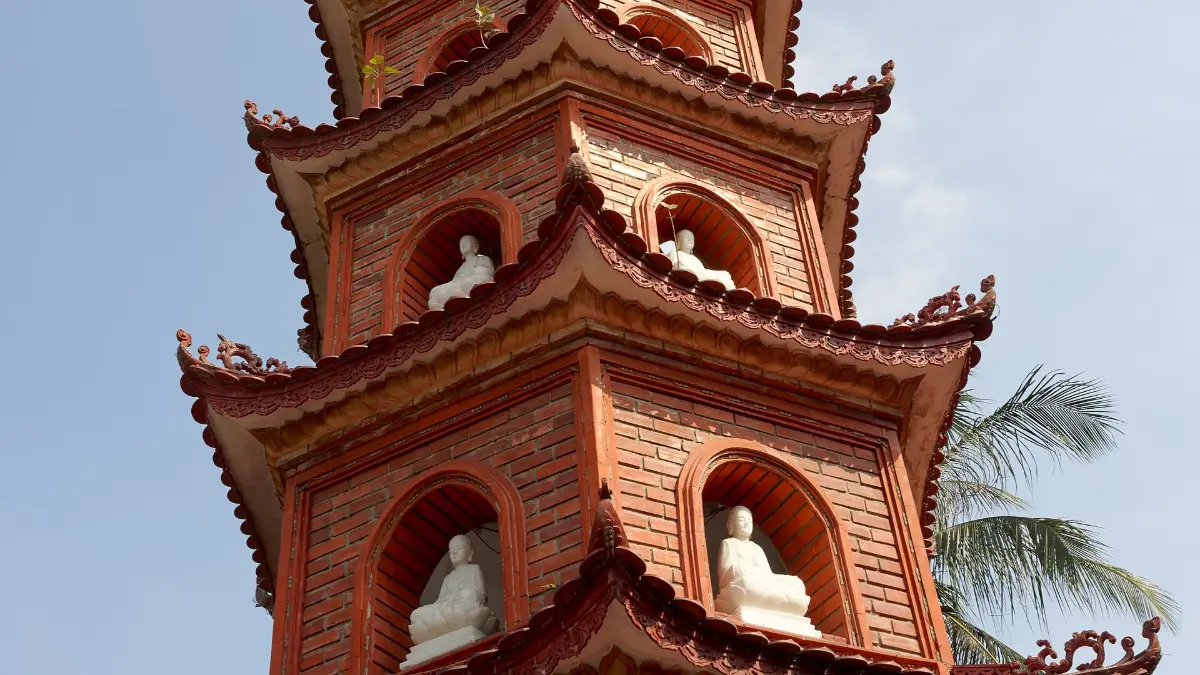
The 15-metre stupa has 11 storeys, each with six arched niches. Every niche holds a white gemstone statue of Amitabha Buddha, 66 in total, and the top is crowned by a nine-tier gemstone lotus. The number 11 and the lotus symbolise the path to enlightenment. Older, smaller memorial stupas of former abbots stand around it in the garden.
3. The Bodhi tree
In the garden grows a Bodhi tree taken from a cutting of the sacred tree at Bodh Gaya in India, where the Buddha attained enlightenment. It was presented in 1959 by Indian President Rajendra Prasad during his visit to Hanoi. Worshippers often tie wishes or pray beneath it.
4. The main sanctuary
The main hall follows the classic Vietnamese layout of front hall, incense hall and upper hall, with dozens of lacquered and gilded statues. The best known is a gilded wooden statue of Shakyamuni Buddha entering Nirvana, often described as one of the finest of its kind in Vietnam. Look up at the carved roof beams and the red-and-gold panels with Chinese characters.
5. Corridors, steles and the Mother Goddess shrine
Side corridors hold the memorial hall for monks and old stone steles recording restorations, including the 17th-century works. At the front of the courtyard is a shrine to the Mother Goddesses (Tam Toa Thanh Mau), showing how Buddhism and Vietnamese folk belief sit side by side.
6. West Lake views and sunset
The low wall along the water is one of the best free sunset spots in Hanoi. In the late afternoon the stupa catches the light and the lake turns gold behind it.
Tran Quoc Pagoda Opening Hours and Entrance Fee (2026)
| Item | Details |
|---|---|
| Entrance fee | Free for all visitors; small donations in the boxes are welcome |
| Normal hours | Daily, about 8:00–16:00 |
| 1st and 15th of the lunar month | Longer hours, very crowded with local worshippers |
| Tet (Lunar New Year) | Open late on New Year’s Eve; huge crowds in the first days of the year |
| Parking | Motorbike parking near the gate on Thanh Nien Road (small fee); cars drop off and wait elsewhere |
The pagoda is an active place of worship managed by its resident monks and has no official website, so hours can change on festival days; arrive before 16:00 to be safe.
Rules and Etiquette at Tran Quoc Pagoda
- Dress modestly: cover shoulders and knees; shorts, short skirts and sleeveless tops may be turned away at the gate.
- Remove your shoes where you see others do so before entering a hall.
- Keep quiet and do not walk between worshippers and the altar.
- Do not climb or touch the stupa, statues or the Bodhi tree.
- Ask before photographing monks or people praying; flash photography inside halls is discouraged.
- Offerings: if you light incense, place it in the burners, never on the altars.
How to Get to Tran Quoc Pagoda
| From | How | Time |
|---|---|---|
| Hoan Kiem Lake / Old Quarter | Grab or taxi via Phan Dinh Phung and Thanh Nien Road (about 3.5 km) | 10–15 minutes |
| Hoan Kiem Lake / Old Quarter | Cyclo or electric buggy tours often include West Lake | 20–30 minutes |
| Ho Chi Minh Mausoleum | Taxi, or walk via Quan Thanh Temple and Thanh Nien Road (about 2 km) | 5 minutes / 25 minutes |
| Quan Thanh Temple | Walk north along Thanh Nien Road (about 1 km) | 12–15 minutes |
| Anywhere in Hanoi | City buses stop on Thanh Nien and Yen Phu roads; check Google Maps for current routes | Varies |
See our guide to getting around Hanoi for taxis, Grab and buses.
Best Time to Visit Tran Quoc Pagoda
| When | What to expect |
|---|---|
| October–December | Dry, mild and clear; the most comfortable season for West Lake |
| January–April | Cool, sometimes misty or drizzly; Tet and spring festival crowds |
| May–September | Hot and humid with heavy showers; go early in the morning |
| Early morning (8:00–9:30) | Quietest time, soft light on the stupa |
| Late afternoon (15:00–16:00) | Warm light; stay on the lakeside afterwards for sunset |
| 1st and 15th lunar days | Very busy with worshippers; interesting atmosphere but crowded |
Local Expert Tips for Tran Quoc Pagoda
These tips come from years of arranging Hanoi tours for international travellers.
- Pair it with Quan Thanh Temple and the Ho Chi Minh Mausoleum area for an easy half-day; the three are within 2 km of each other.
- Carry a light scarf or sarong if you are wearing shorts or a vest; it saves a trip back to the hotel.
- The pagoda closes before sunset, so visit at around 15:30, then watch the sunset from the Thanh Nien Road embankment.
- For the classic photo of the stupa, stand at the end of the causeway rather than inside the courtyard.
- Try a West Lake shrimp cake (banh tom Ho Tay) at the lakeside restaurants nearby; see our Hanoi food and drink guide.
- Avoid lunar 1st and 15th days if you want quiet photos; go on those days if you want to see local worship.
Tran Quoc Pagoda vs Quan Thanh Temple
| Tran Quoc Pagoda | Quan Thanh Temple | |
|---|---|---|
| Religion | Buddhist pagoda | Taoist temple (Huyen Thien Tran Vu) |
| Age | 6th century (moved here 1615) | 11th century (Ly dynasty) |
| Highlight | 11-storey lotus stupa, Bodhi tree | Bronze statue of Tran Vu, nearly 4 m tall, cast in 1677 |
| Entrance fee | Free | 10,000 VND for adults |
| Setting | Island on West Lake | Street corner by Truc Bach Lake |
| Time needed | 30–45 minutes | 20–30 minutes |
Our view: Tran Quoc is the more photogenic stop thanks to the stupa and the lake; Quan Thanh is the more historic interior with its huge bronze statue. They are only 1 km apart, so see both.
Nearby Attractions
- West Lake (Ho Tay): Hanoi’s largest lake, for cycling, cafes and sunsets.
- Quan Thanh Temple: one of the Four Sacred Guardian Temples of Thang Long, 1 km south.
- Ho Chi Minh Mausoleum and Ba Dinh Square: about 2 km.
- Imperial Citadel of Thang Long: UNESCO World Heritage Site, about 2.5 km.
- Hanoi Old Quarter and Dong Xuan Market: about 2.5–3 km.
- Vietnam Museum of Ethnology: about 6 km west, best by taxi.
Sightseeing in Hanoi for First-Time Visitors: Where Tran Quoc Pagoda Fits
One day in Hanoi? Start at the Ho Chi Minh Mausoleum early, walk to Quan Thanh Temple and Tran Quoc Pagoda, continue to the Temple of Literature after lunch, and finish at Hoan Kiem Lake and the Old Quarter. With two days, add the Hoa Lo Prison Museum and the Museum of Ethnology. Our Hanoi travel tips cover money, safety and scams.
Plan your trip with our Hanoi travel guide and Hanoi tours. Contact Vietnam Tour Expert Team for a free custom itinerary.
Frequently Asked Questions about Tran Quoc Pagoda
1. Is Tran Quoc Pagoda free to enter?
Yes. Tran Quoc Pagoda has no entrance fee; you can leave a small donation in the boxes inside if you wish.
2. What are the opening hours of Tran Quoc Pagoda?
Tran Quoc Pagoda is open daily, roughly 8:00–16:00, with longer hours on the 1st and 15th days of the lunar month and around Tet.
3. How old is Tran Quoc Pagoda?
Tran Quoc Pagoda was founded in the mid-6th century under Ly Nam De (544–548), making it about 1,500 years old and the oldest pagoda in Hanoi.
4. Where is Tran Quoc Pagoda located?
Tran Quoc Pagoda is at 46 Thanh Nien Road, Tay Ho Ward, on a small islet on the eastern side of West Lake, about 3.5 km north of Hoan Kiem Lake.
5. What is Tran Quoc Pagoda famous for?
Tran Quoc Pagoda is famous for being Hanoi’s oldest pagoda, for its 15-metre, 11-storey lotus stupa with 66 gemstone Buddha statues, and for its lakeside setting.
6. How tall is the stupa at Tran Quoc Pagoda?
The Lotus Stupa at Tran Quoc Pagoda is 15 metres tall with 11 storeys, each holding six gemstone Amitabha statues; it was completed in 2003.
7. Where does the Bodhi tree at Tran Quoc Pagoda come from?
The Bodhi tree at Tran Quoc Pagoda is a cutting from the sacred tree at Bodh Gaya, India, presented in 1959 by Indian President Rajendra Prasad.
8. Why was Tran Quoc Pagoda moved?
Tran Quoc Pagoda originally stood on the Red River bank, but erosion forced its move to the Golden Fish islet in West Lake in 1615.
9. What should I wear to Tran Quoc Pagoda?
Cover your shoulders and knees at Tran Quoc Pagoda; shorts, short skirts and sleeveless tops are not appropriate in an active place of worship.
10. How long do I need at Tran Quoc Pagoda?
Most visitors need 30–45 minutes at Tran Quoc Pagoda, or up to two hours if combined with a walk along West Lake.
11. What is the best time to visit Tran Quoc Pagoda?
Visit Tran Quoc Pagoda early on a weekday morning for calm, or at about 15:30 so you can watch the sunset over West Lake after it closes.
12. How do I get to Tran Quoc Pagoda from the Old Quarter?
Take a Grab or taxi from the Old Quarter to Tran Quoc Pagoda; the 3.5 km ride takes 10–15 minutes. See our Hanoi transport guide.
13. Is Tran Quoc Pagoda worth visiting?
Yes. Tran Quoc Pagoda is free, photogenic and historic, and it is easy to combine with Quan Thanh Temple and the Ho Chi Minh Mausoleum.
14. Can I take photos at Tran Quoc Pagoda?
Photography is allowed in the grounds of Tran Quoc Pagoda; be discreet inside the halls and ask before photographing monks or worshippers.
15. Is Tran Quoc Pagoda crowded?
Tran Quoc Pagoda is busiest on the 1st and 15th of the lunar month, at Tet and on weekend afternoons; weekday mornings are quietest.
16. What is near Tran Quoc Pagoda?
Near Tran Quoc Pagoda are West Lake, Truc Bach Lake, Quan Thanh Temple (1 km) and the Ho Chi Minh Mausoleum (about 2 km).
17. Is Tran Quoc Pagoda a UNESCO site?
No. Tran Quoc Pagoda is not a UNESCO site, but it is a listed national historical and cultural relic of Vietnam.
Related Posts
Hanoi Egg Coffee (2026): Best Cafés, Prices, History & Recipe
Hanoi Train Street (2026): Is It Open? Train Times, Cafés & Rules
Hanoi Shopping Guide: Best Markets, Streets & Souvenirs to Buy (2026)
Hanoi Travel Tips: Essential Things to Know Before You Go (2026)
Hanoi Transportation: How to Get Around Hanoi & From Noi Bai Airport (2026 Guide)