Hanoi Transportation: How to Get Around Hanoi & From Noi Bai Airport (2026 Guide)
The quickest way from Noi Bai Airport to Hanoi Old Quarter is a Grab, Xanh SM or Be car: about 45–60 minutes for roughly 250,000–400,000 VND (US$10–15). The cheapest is airport bus 86 at 45,000 VND (about US$1.70), running every 25–30 minutes to Long Bien, Hoan Kiem Lake and Hanoi Station. Inside the centre, walk or use ride-hailing apps.
Status (checked October 2026): Hanoi has two metro lines running: Line 2A (Cat Linh–Yen Nghia) and the elevated section of Line 3 (Nhon–Cau Giay); the underground stretch of Line 3 to Hanoi Station is still under construction and expected around 2027. Paper metro tokens have been replaced by QR tickets and contactless payment. The Ho Chi Minh Mausoleum is closed for maintenance from 4 September to 2 November 2026, and the Hanoi Opera House is under renovation, so plan routes around both.
Key takeaways:
- Airport to Old Quarter: ride-hailing car 45–60 minutes, about 250,000–400,000 VND; bus 86 about 50–70 minutes, 45,000 VND.
- Grab, Xanh SM (all-electric) and Be show a fixed fare before you book – the easiest way to avoid taxi overcharging.
- The metro is clean and cheap (about 9,000–19,000 VND a ride) but serves the west of the city, not the Old Quarter itself.
- Riding a motorbike legally needs a motorcycle licence plus a 1968-Convention International Driving Permit; fines without one start at 2 million VND.
- Trains to Lao Cai (for Sapa), Hue and Saigon leave from Hanoi Station; buses and limousine vans are faster for Halong Bay and Ninh Binh.
Hanoi Transportation at a Glance
| Main airport | Noi Bai International Airport (HAN) – Terminal 1 domestic, Terminal 2 international; about 27–30 km north of the Old Quarter |
|---|---|
| Airport to Old Quarter by car | 45–60 minutes; Grab/Xanh SM/Be about 250,000–400,000 VND (US$10–15); metered taxi about 300,000–400,000 VND |
| Airport bus 86 | 45,000 VND (about US$1.70), every 25–30 minutes, roughly 05:15–22:00 |
| Public airport buses | Routes 17, 90, 109, 07 and others, about 9,000–15,000 VND, slower with many stops |
| Ride-hailing apps | Grab, Xanh SM, Be – cars and motorbike taxis with upfront prices |
| Metro | Line 2A Cat Linh–Yen Nghia (12 stations) and Line 3 Nhon–Cau Giay (8 stations); about 05:30–22:00; single fares about 9,000–19,000 VND, day pass 40,000 VND |
| City buses | Extensive network, about 7,000–15,000 VND (US$0.30–0.60) a ride depending on route length |
| Short Grab ride in the centre | Car about 30,000–80,000 VND; motorbike taxi about 15,000–40,000 VND |
| Main railway station | Hanoi Station (Ga Ha Noi), Le Duan Street – trains to Lao Cai, Hue, Da Nang and Saigon |
| Old Quarter location | Hoan Kiem ward (new administrative unit since 1 July 2025) |
| Motorbike licence rule | Home motorcycle licence + 1968 Vienna Convention IDP, or a Vietnamese licence |
How Do I Get from Noi Bai Airport to Hanoi Old Quarter?
Book a Grab, Xanh SM or Be car in the arrivals hall for the most convenient trip (about 45–60 minutes), or take bus 86 for the cheapest comfortable ride. Both terminals have official taxi ranks and bus stops outside the arrivals level.
The airport sits about 27–30 km north of the centre, and the drive crosses the Red River on the Nhat Tan bridge or Thang Long bridge. Allow 75–90 minutes during weekday rush hours (roughly 07:00–09:00 and 16:30–19:00) and on rainy evenings. Most Old Quarter hotels sit on narrow one-way streets, so drivers may stop at the nearest corner.
| Option | Time to Old Quarter | Typical price | Best for |
|---|---|---|---|
| Grab / Xanh SM / Be car | 45–60 min | About 250,000–400,000 VND (US$10–15) | Most travellers, couples, families |
| Metered taxi (official rank) | 45–60 min | About 300,000–400,000 VND | Travellers without a phone app |
| Hotel or tour-operator pick-up | 45–60 min | About US$15–25 per car | Late-night arrivals, groups, first-timers |
| Bus 86 (airport express) | 50–70 min | 45,000 VND | Budget travellers with light luggage |
| Public bus 17 / 90 / 109 / 07 | 60–90 min + transfer | About 9,000–15,000 VND | Backpackers with time to spare |
1. Grab, Xanh SM and Be
Ride-hailing apps give a fixed price before you confirm, which removes the risk of a manipulated meter. Xanh SM uses an all-electric VinFast fleet with uniformed drivers, while Grab offers the widest choice of car sizes, including 7-seaters for families. Pick-up points are signposted outside the arrivals halls; follow the app’s map and check the number plate before getting in. Fares rise at peak times and in heavy rain.
2. Official taxis
Use only the official taxi rank outside arrivals and choose well-known companies such as Mai Linh, G7 or Taxi Group. Ignore drivers who approach you inside the terminal. Make sure the meter starts at zero, and agree beforehand whether airport and road charges are included.
3. Airport bus 86
Bus 86 is an orange express bus linking both terminals with Hanoi Station via Long Bien bus station, the Hoan Kiem Lake area and the Opera House area. It costs 45,000 VND, paid in cash on board, runs about every 25–30 minutes from early morning until about 22:00, and has space for suitcases. For the Old Quarter, get off around Long Bien or Tran Quang Khai Street near Hoan Kiem Lake, then walk or take a short Grab ride.
4. Public city buses 17, 90, 109 and 07
Regular city buses cost about 9,000–15,000 VND on these longer airport routes but stop frequently and have little luggage space. Bus 17 runs to Long Bien, the closest public route to the Old Quarter; bus 90 goes to Kim Ma/Hao Nam near Cat Linh metro station; bus 109 ends at My Dinh bus station; and bus 07 terminates at Cau Giay. Most run from about 05:00 to 21:00–22:00.
5. Private transfer
A pre-booked driver waiting with a name sign is the calmest option after a long-haul flight, especially for arrivals after 22:00 when buses stop. Most Hanoi hotels and tour operators arrange this for roughly US$15–25 per car, depending on vehicle size.
What Is the Best Way to Get Around Hanoi?
Walk around the Old Quarter and Hoan Kiem Lake, and use Grab, Xanh SM or Be for anything further – a short car ride in the centre usually costs about 30,000–80,000 VND (US$1.20–3). The metro and buses are useful for longer trips across the city.
1. Walking
The Old Quarter, Hoan Kiem Lake, the French Quarter and St Joseph’s Cathedral are all within about 15–20 minutes’ walk of each other. Pavements are often used for parking and street food, so you will sometimes walk in the road. To cross, walk slowly and steadily without stopping or running – riders will flow around you. From Friday 19:00 (18:00 in winter) to Sunday midnight, the streets around Hoan Kiem Lake and parts of the Old Quarter become a car-free walking zone.
2. Grab, Xanh SM and Be
These apps are the easiest way to get around: you see the price in advance, the route is tracked and you can pay in cash or by card. Choose a car (GrabCar, Xanh SM Taxi) or a motorbike taxi (GrabBike, Xanh SM Bike, BeBike) – the bike option is cheaper and faster in traffic, and the driver provides a helmet. Register the app with your home number before travel, as an eSIM without a local number may not receive Vietnamese SMS codes.
3. Metered taxis
Traditional taxis are plentiful and fine if you use reputable brands (Mai Linh, G7, Taxi Group) and insist on the meter. Avoid unmarked cars or drivers touting outside tourist sites, and have small notes ready because drivers often lack change.
4. Hanoi Metro
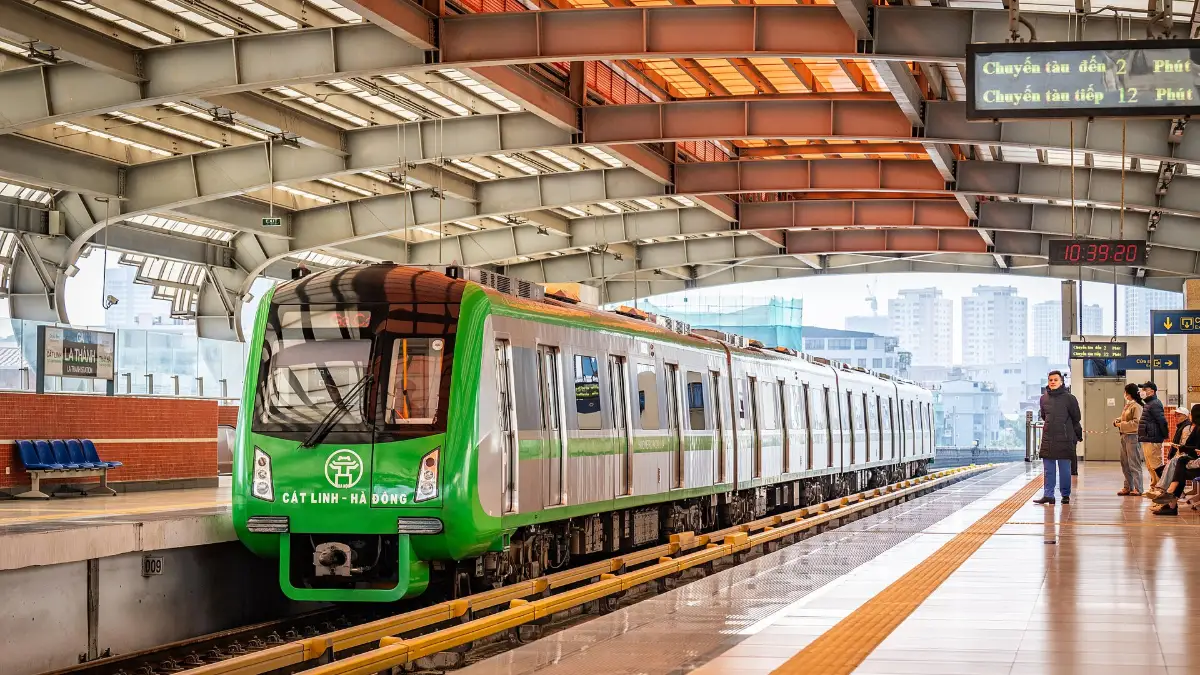
Two lines are open, both elevated (see the operator’s Hanoi Metro website). Line 2A runs 13 km from Cat Linh to Yen Nghia (Ha Dong) with 12 stations, and Line 3 runs about 8.5 km from Nhon to Cau Giay with 8 stations; services run roughly 05:30–22:00 every 6–10 minutes. Single fares are distance-based at about 9,000–19,000 VND, and a day pass costs 40,000 VND. Buy QR tickets at station counters or in the Hanoi Metro app; contactless bank cards and phone wallets are accepted at many gates. The 4 km underground section of Line 3 from Cau Giay to Hanoi Station (via Kim Ma, Cat Linh and Van Mieu) is due around 2027, so neither line reaches the Old Quarter yet. For visitors, Line 2A is handy for the Temple of Literature area (Cat Linh station) and Line 3 for the Vietnam Museum of Ethnology area.
5. City buses
Hanoi has well over 100 bus routes, most costing about 7,000–15,000 VND a ride depending on route length, including electric VinBus services. Buses are cheap and air-conditioned but crowded at peak times, and signage is mainly in Vietnamese – Google Maps and the Tim Buyt app show routes and live arrivals. Have small notes ready, as conductors may not change large bills.
6. Cyclos
A cyclo (pedal rickshaw) ride around the Old Quarter is a gentle sightseeing experience rather than transport. Agree the price, the duration and whether it is per person before you sit down; hotels and tour operators can arrange cyclos with fixed rates, which avoids disputes.
7. Electric sightseeing cars
Open-sided electric buggies loop around Hoan Kiem Lake and the Old Quarter on a fixed route, with ticket points near the lake. A loop takes roughly 35–45 minutes and is a good option for older travellers or families on a hot day.
8. Hop-on hop-off buses
Red double-decker sightseeing buses connect major sights such as the Opera House area, Hoan Kiem Lake, the Temple of Literature and Ba Dinh Square, with tickets valid for several hours. They suit a quick overview on a first day.
9. Renting a motorbike
Riding in Hanoi traffic is not recommended for inexperienced riders, and it is only legal with the right licence. Vietnam recognises an International Driving Permit issued under the 1968 Vienna Convention, carried with your home motorcycle licence; permits issued under the 1949 Geneva Convention (the type issued in the US, for example) are not accepted. Under Decree 168/2024, in force since 1 January 2025, riding a motorbike up to 125cc without a valid licence is fined 2–4 million VND, and above 125cc 6–8 million VND, with much heavier penalties for drink-riding. Travel insurers commonly reject claims from unlicensed riders, so a GrabBike or a motorbike tour with a driver is the safer choice.
| Getting around | Typical cost | Good for | Watch out for |
|---|---|---|---|
| Walking | Free | Old Quarter, Hoan Kiem Lake, French Quarter | Crowded pavements, crossing busy roads |
| GrabBike / Xanh SM Bike | About 15,000–40,000 VND | Solo trips, beating traffic | Rain, heavy bags |
| Grab car / Xanh SM Taxi | About 30,000–80,000 VND in the centre | Couples, families, evenings | Surge pricing at peak times |
| Metro | About 9,000–19,000 VND | West Hanoi, Cau Giay, Ha Dong | Does not reach the Old Quarter yet |
| City bus | About 7,000–15,000 VND | Budget travel, long cross-city trips | Vietnamese-only signage, crowds |
| Cyclo | Agree before riding | Short sightseeing loop | Unclear per-person pricing |
How Do I Travel from Hanoi to Halong Bay, Ninh Binh, Sapa and Beyond?
Use expressway limousine vans or private cars for Halong Bay and Ninh Binh, a limousine bus or the night train for Sapa, and a domestic flight for Hue, Da Nang or Ho Chi Minh City. Most cruise companies and tour operators include hotel pick-up in the Old Quarter.
| Destination | Best way | Travel time | Typical price |
|---|---|---|---|
| Halong Bay / Lan Ha Bay | Limousine van, cruise shuttle or private car via the expressway | About 2.5–3 hours | Shuttle about US$15–25 one way; often included with cruises |
| Ninh Binh (Trang An, Tam Coc) | Private car, limousine van or train | About 1.5–2 hours by road | Limousine van about US$8–15 one way |
| Sapa | Sleeper/limousine bus via the Noi Bai–Lao Cai expressway, or night train to Lao Cai + 1 hour by road | About 5.5–6 hours by bus; train about 8 hours + transfer | Bus about US$12–25; train soft sleeper about 440,000–460,000 VND |
| Hue | Domestic flight or overnight train | Flight about 1 hour 10 minutes; train about 12.5–13 hours | Train soft sleeper about 1.1–1.25 million VND |
| Da Nang / Hoi An | Domestic flight | About 1 hour 15 minutes (plus 45 minutes by road to Hoi An) | Varies by season and airline |
| Ho Chi Minh City | Domestic flight (train is a slow-travel option) | Flight about 2 hours 10 minutes; train about 33 hours | Train soft sleeper about 1.7–1.8 million VND |
1. Trains from Hanoi Station
Vietnam Railways trains leave from Hanoi Station on Le Duan Street, about 2 km south-west of Hoan Kiem Lake. The night train to Lao Cai (for Sapa) leaves late evening and arrives around dawn after roughly 7 hours 40 minutes; private tourist carriages attached to the same trains offer extra comfort. North–South Reunification Express trains reach Hue in about 12.5–13 hours and Saigon in about 33 hours. Book on the official Vietnam Railways (DSVN) website or through a trusted agent, and bring your passport when boarding.
2. Limousine vans and buses
Nine- to eleven-seat “limousine” vans with reclining seats are the most popular way to reach Halong Bay and Ninh Binh, with Old Quarter pick-up. For Sapa, sleeper buses and limousine buses take the Noi Bai–Lao Cai expressway. Long-distance public buses use My Dinh, Giap Bat and Gia Lam bus stations, but are less convenient for visitors.
3. Domestic flights
Vietnam Airlines, Vietjet, Bamboo Airways and Vietravel Airlines fly from Noi Bai Terminal 1 to Hue, Da Nang, Nha Trang, Dalat, Phu Quoc and Ho Chi Minh City. Arrive at least 90 minutes before domestic departures, and allow extra time to reach the airport in rush hour. Check the official Noi Bai International Airport website for terminal information.
How Can I Avoid Transport Scams in Hanoi?
Book cars through apps or your hotel, agree prices in advance for cyclos and private drivers, and keep small notes. Most transport in Hanoi is honest, but a few tricks target first-time visitors.
1. Fake or rigged taxis
Look-alike taxi brands and fast meters exist. Use the official rank, app-booked cars, or ask your hotel to call a taxi.
2. Unclear cyclo and motorbike prices
Some drivers quote “per person” or “per hour” only at the end. Confirm the total in writing (or on your phone calculator) before starting.
3. Confusing banknotes
The 10,000 and 100,000 VND notes, and the 20,000 and 500,000 VND notes, look similar in poor light. Count your change and keep large notes separate.
4. Fake bus and train tickets
Buy train tickets only from the official DSVN channels or reputable agents, and book buses and vans through your hotel or tour operator rather than street touts.
Local Expert Tips for Getting Around Hanoi
These tips come from years of arranging Hanoi tours for international travellers.
- Install Grab and Xanh SM and register them before you fly, so you can book a car the moment you land.
- Save your hotel address in Vietnamese, including the new ward name (most Old Quarter hotels are now in Hoan Kiem ward), to show drivers.
- Arriving after 22:00? Pre-book a transfer – buses have stopped and app prices are higher.
- Avoid long road journeys at 07:00–09:00 and 16:30–19:00 on weekdays, when the airport road and ring roads clog up.
- For the metro, take a Grab to Cat Linh station and combine Line 2A with a visit to the Temple of Literature area.
- Choose a GrabBike only if you are comfortable on a motorbike; always wear the helmet the driver offers.
- Carry 10,000–50,000 VND notes for buses, cyclos and street vendors.
- For Halong Bay, Ninh Binh and Sapa, book transport with your cruise or tour – it saves time and pick-up is from your hotel door.
Plan Your Hanoi Trip
Most of Hanoi’s highlights are a short walk or ride apart. Start in the Hanoi Old Quarter and around Hoan Kiem Lake, walk to St Joseph’s Cathedral and Dong Xuan Market, then take a Grab to the Temple of Literature, Hoa Lo Prison and West Lake. The metro’s Line 3 is the easiest way to the Vietnam Museum of Ethnology, while the Ho Chi Minh Mausoleum reopens after its autumn maintenance closure. Read our Hanoi travel tips, guide to Hanoi food and drinks and Hanoi shopping guide, and for onward journeys see Hanoi to Halong Bay, our Halong Bay cruise guide, Hanoi to Sapa and how to get to and around Ninh Binh.
Plan your trip with our Hanoi travel guide and Hanoi tours. Contact Vietnam Tour Expert Team for a free custom itinerary.
Frequently Asked Questions about Hanoi Transportation
1. How much is a Grab from Noi Bai Airport to Hanoi Old Quarter?
A Grab, Xanh SM or Be car from Noi Bai Airport to the Old Quarter usually costs about 250,000–400,000 VND (US$10–15), shown as a fixed price before you book. Fares rise at peak times and in heavy rain.
2. How long does it take from Noi Bai Airport to Hanoi Old Quarter?
The 27–30 km drive takes about 45–60 minutes in normal traffic and up to 90 minutes in rush hour. Bus 86 takes about 50–70 minutes.
3. How much is bus 86 from Hanoi airport?
Bus 86 costs 45,000 VND (about US$1.70) per person, paid in cash on board. It runs roughly every 25–30 minutes from early morning until about 22:00 between both terminals and Hanoi Station.
4. Which public buses go from Noi Bai Airport to central Hanoi?
Besides express bus 86, regular city buses 17 (to Long Bien), 90 (to Kim Ma/Hao Nam), 109 (to My Dinh) and 07 (to Cau Giay) serve the airport for about 9,000–15,000 VND. They are slower and have little luggage space.
5. Is Grab available in Hanoi?
Yes. Grab works across Hanoi for cars, motorbike taxis and food delivery, alongside Xanh SM and Be. You can pay in cash or link a foreign bank card.
6. What is Xanh SM in Hanoi?
Xanh SM is a Vietnamese ride-hailing and taxi service using an all-electric VinFast fleet. You can book cars or motorbikes through its app or hail its green taxis on the street in Hanoi.
7. Does Hanoi have a metro?
Yes. Hanoi has two elevated lines in service: Line 2A (Cat Linh–Yen Nghia, 12 stations) and Line 3 (Nhon–Cau Giay, 8 stations). They run about 05:30–22:00 every 6–10 minutes.
8. Does the Hanoi metro go to the Old Quarter?
Not yet. The underground section of Line 3 from Cau Giay to Hanoi Station is expected around 2027, so the nearest metro stations to the Old Quarter today are Cat Linh (Line 2A) and Cau Giay (Line 3).
9. How much does the Hanoi metro cost?
Single metro tickets in Hanoi cost about 9,000–19,000 VND depending on distance, and a day pass costs 40,000 VND. Buy QR tickets at counters or in the Hanoi Metro app, or tap a contactless bank card where accepted.
10. How much does a bus ride cost in Hanoi?
A city bus ride in Hanoi typically costs about 7,000–15,000 VND (US$0.30–0.60) depending on route length. Express airport bus 86 costs 45,000 VND.
11. How much is a taxi in Hanoi?
Short taxi or Grab car rides within central Hanoi usually cost about 30,000–80,000 VND. A motorbike taxi on the same route costs roughly half.
12. Can tourists rent a motorbike in Hanoi?
Tourists can rent a motorbike in Hanoi, but riding is legal only with a home motorcycle licence plus a 1968-Convention International Driving Permit, or a Vietnamese licence. Without one, Decree 168/2024 sets fines of 2–4 million VND for bikes up to 125cc.
13. Is it safe to walk around Hanoi?
Yes, central Hanoi is generally safe to walk, though traffic is the main hazard. Cross slowly and steadily, and watch your bag and phone in crowded areas.
14. When is the Hanoi walking street open?
The car-free walking zone around Hoan Kiem Lake and parts of the Old Quarter operates from Friday evening (19:00, or 18:00 in winter) until midnight on Sunday.
15. How do I get from Hanoi to Sapa?
Take a limousine or sleeper bus via the expressway (about 5.5–6 hours), or the night train from Hanoi Station to Lao Cai (about 7 hours 40 minutes) followed by about an hour by road to Sapa.
16. How do I get from Hanoi to Halong Bay?
Most visitors use a cruise shuttle, limousine van or private car via the expressway, taking about 2.5–3 hours from Hanoi Old Quarter. Many cruises include round-trip transfers.
17. How do I get from Hanoi to Ninh Binh?
By road it takes about 1.5–2 hours from Hanoi to Ninh Binh by private car or limousine van. Trains from Hanoi Station also stop at Ninh Binh but run less often.
18. Should I fly or take the train from Hanoi to Hue?
Fly if time matters: Hanoi to Hue takes about 1 hour 10 minutes by air versus about 12.5–13 hours by overnight train. The train suits travellers who want a scenic, budget-friendly sleeper journey.
Related Posts

Hanoi Egg Coffee (2026): Best Cafés, Prices, History & Recipe

Hanoi Train Street (2026): Is It Open? Train Times, Cafés & Rules

Hanoi Shopping Guide: Best Markets, Streets & Souvenirs to Buy (2026)

Hanoi Travel Tips: Essential Things to Know Before You Go (2026)

Hanoi Food & Drinks: 15 Must-Try Dishes, Egg Coffee & Where to Eat (2026)