Hanoi Egg Coffee (2026): Best Cafés, Prices, History & Recipe
Hanoi egg coffee (cà phê trứng) is strong Vietnamese robusta topped with a thick, sweet foam of egg yolk whisked with sugar and condensed milk. It was created in Hanoi in the 1940s by Nguyễn Văn Giảng, whose family still runs Café Giảng at 39 Nguyễn Hữu Huân in the Old Quarter. A cup usually costs about 35,000–60,000 VND (roughly US$1.30–2.30).
Status (checked October 2026): the best-known egg coffee cafés – Café Giảng, Café Đinh, Café Phố Cổ, The Note Coffee and Loading T – are open as normal. Café Giảng and Café Đinh generally open from about 07:00 until late evening, while Loading T is a daytime café; small family cafés can change hours or close for holidays such as Tết, so check Google Maps before you go. October brings the first cool evenings, the start of hot egg coffee season in Hanoi.
Why Hanoi egg coffee is worth trying:
- A drink born in Hanoi: egg coffee was invented here in the 1940s and is still made by the inventor’s family, so you can taste it where it began.
- Dessert and coffee in one cup: the foam is rich and custard-like – many travellers compare it with tiramisu – while the robusta underneath keeps it from being too sweet.
- Cheap and easy: a cup costs about the same as a bottle of water in a Western city, and you will find it all over the Old Quarter.
- A window into café culture: hidden alleys, low stools, staircases up to lake-view balconies – the cafés are as memorable as the drink.
- Perfect for Hanoi’s cool months: served hot in a bowl of warm water, it is a favourite on drizzly winter afternoons; in summer, try it iced.
Hanoi Egg Coffee at a Glance
| Vietnamese name | Cà phê trứng (literally “egg coffee”); the hot version is cà phê trứng nóng, the iced one cà phê trứng đá |
|---|---|
| What it is | Phin-filtered Vietnamese robusta coffee topped with egg yolk whisked with sugar and sweetened condensed milk into a thick foam |
| Origin | Created in Hanoi in the 1940s by Nguyễn Văn Giảng, then a bartender at the Metropole Hotel, when fresh milk was scarce; he opened Café Giảng in 1946 |
| Where to try | Café Giảng (39 Nguyễn Hữu Huân), Café Đinh (13 Đinh Tiên Hoàng, 2nd floor), Café Phố Cổ (11 Hàng Gai), The Note Coffee (64 Lương Văn Can), Loading T (8 Chân Cầm, 2nd floor) – all in or next to the Old Quarter, now Hoan Kiem ward |
| Price | About 35,000–60,000 VND (roughly US$1.30–2.30) per cup; slightly more at cafés with a lake view |
| Hot or iced | Both. Hot egg coffee is often served in a small bowl of hot water to keep it warm; iced egg coffee is popular in summer |
| Best time | October to March, when Hanoi is cool; mornings and weekday afternoons are quieter at the famous cafés |
| Allergens and raw egg | Contains egg yolk (whipped, not fully cooked) and dairy (condensed milk). Pregnant travellers, young children and anyone with an egg allergy or weakened immunity should skip it |
| Variations | Egg cocoa, egg matcha, egg with green bean and other house specials, depending on the café |
| Find it | Google Maps · Tripadvisor · Wikipedia |
Is Hanoi Egg Coffee Worth Trying?
Yes – for most visitors, a cup of egg coffee is one of the small, essential pleasures of Hanoi, and it costs very little. The real question is how much time to give it: one cup at an atmospheric café is enough for most people, while coffee lovers can easily make a short café crawl of it.
- Best for: food lovers, first-time visitors to Hanoi, anyone with a sweet tooth, and travellers who want a relaxed break between sights in the Old Quarter.
- Skip if: you are pregnant, allergic to eggs, avoiding raw egg for health reasons, or vegan – there are plenty of other Vietnamese coffees to try instead (see below).
- Short on time: walk to Café Giảng, a few minutes from Hoan Kiem Lake, or to Café Đinh on the lake shore; 30–45 minutes is enough for a cup.
History of Hanoi Egg Coffee
Egg coffee was invented by Nguyễn Văn Giảng, who worked as a bartender at the Metropole Hotel in Hanoi – today the Sofitel Legend Metropole Hanoi – in the 1940s. Fresh milk was hard to find and expensive at the time, during the years of the resistance against French colonial rule, so Giảng whisked egg yolk with sugar as a substitute for milk foam and poured it over strong black coffee.
The drink proved so popular with customers that Giảng left the hotel and opened his own café in 1946 to sell egg coffee under his own name. Café Giảng is now tucked down a narrow alley at 39 Nguyễn Hữu Huân Street, a short walk from Hoan Kiem Lake, where his descendants still prepare the family recipe. According to the family, the original recipe used egg yolk, condensed milk, coffee and a few extra ingredients – reportedly including a little butter and cheese – that remain a family secret.
The recipe spread through the family and then the city. Giảng’s daughter opened Café Đinh on Đinh Tiên Hoàng Street overlooking the lake, and a second Café Giảng run by the family operates on Yên Phụ Street near West Lake. Today almost every café in the Old Quarter serves its own version, and egg coffee has become one of the drinks most associated with Hanoi.
What Does Egg Coffee Taste Like and How Is It Made?
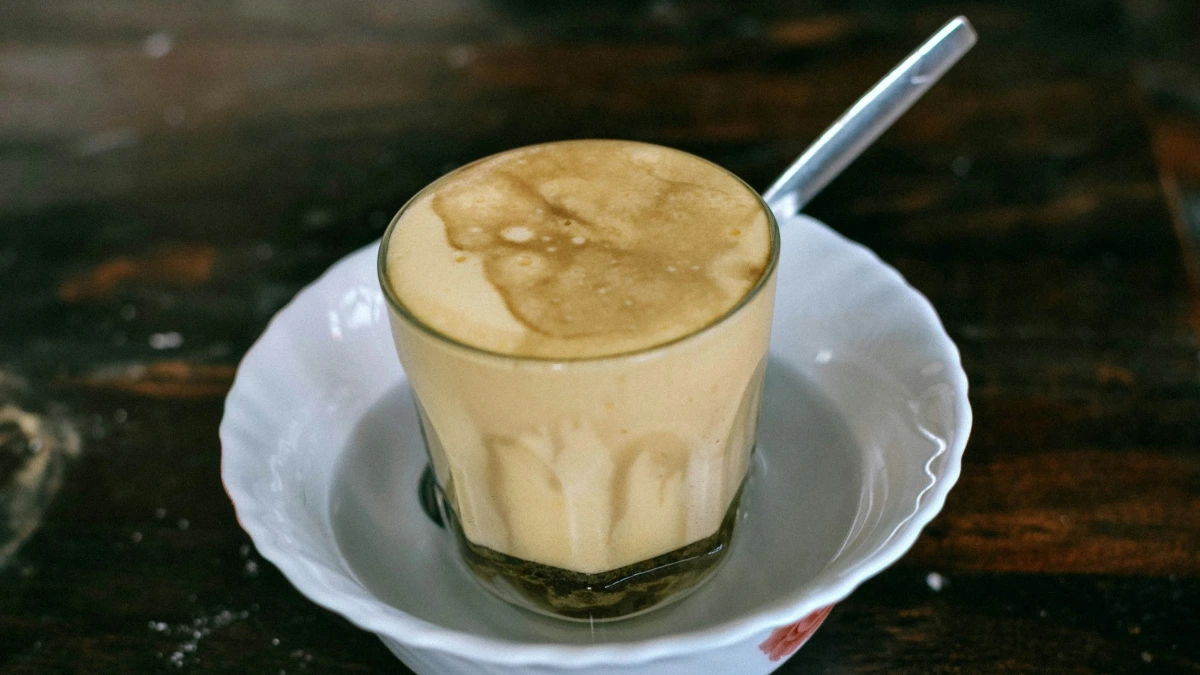
Egg coffee tastes like a warm, coffee-flavoured custard or a liquid tiramisu: the foam is thick, sweet and creamy with a light eggy, vanilla-like note, and the bitter robusta beneath cuts through the sweetness. Well-made egg coffee should not taste of raw egg – a strong eggy smell usually means the yolks were not whisked long enough.
The drink has two layers. At the bottom is a small amount of strong coffee, usually dark-roasted Vietnamese robusta brewed slowly through a phin, the small metal drip filter used all over Vietnam. On top sits the foam: egg yolks whisked with sugar and sweetened condensed milk until pale, thick and almost meringue-like. Hot egg coffee is often served in a small glass or cup standing in a bowl of hot water, which keeps it warm while you sip; you are given a teaspoon to eat some of the foam first or to stir everything together.
Simple Hanoi egg coffee recipe to make at home
This is a home version for one cup. Each Hanoi café has its own proportions and secret touches, so treat it as a starting point.
- Brew about 40–50 ml of strong coffee: ideally Vietnamese robusta in a phin, otherwise a double espresso or very strong filter coffee.
- Separate one very fresh egg and put the yolk in a deep bowl (keep the white for something else). Use pasteurised eggs if you can.
- Add 1–2 teaspoons of sugar and 1–2 tablespoons of sweetened condensed milk to the yolk.
- Whisk hard for several minutes – an electric hand whisk or milk frother makes it much easier – until the mixture is pale, thick and roughly doubled in volume. A drop of vanilla or a teaspoon of hot coffee whisked in helps hide any eggy taste.
- Warm a small cup with hot water, pour in the coffee, then spoon the foam on top so it floats as a thick layer.
- To keep it hot the Hanoi way, stand the cup in a small bowl of hot water. Dust with cocoa or cinnamon if you like, and serve with a teaspoon.
For iced egg coffee, pour the coffee over ice first and spoon the foam on top; for egg cocoa, simply replace the coffee with hot cocoa.
Where to Drink Egg Coffee in Hanoi
The best places to drink egg coffee in Hanoi are Café Giảng, where the drink was born, and Café Đinh, run by the same family, followed by atmospheric Old Quarter cafés such as Café Phố Cổ, The Note Coffee and Loading T. All five are within walking distance of Hoan Kiem Lake.
1. Café Giảng – the original
Address: 39 Nguyễn Hữu Huân Street, Hoan Kiem ward (Old Quarter), down a narrow alley.
This is where egg coffee began, and it is still run by Nguyễn Văn Giảng’s family. Inside, the café is simple, unpretentious and usually busy; hot egg coffee arrives in a little glass standing in a bowl of hot water. Besides the classic, the menu includes egg cocoa, egg matcha, egg with green bean and other variations. Expect a typical egg coffee price of about 35,000–45,000 VND. It can be crowded in the afternoons and at weekends, so mornings are calmer.
Café Giảng on Google Maps · Café Giảng on Tripadvisor
There is also a second family-run Café Giảng at 106 Yên Phụ Street, near West Lake – handy if you are visiting Tran Quoc Pagoda or the West Lake area (Google Maps).
2. Café Đinh – the family café above the lake
Address: 2nd floor, 13 Đinh Tiên Hoàng Street, Hoan Kiem ward, on the east shore of Hoan Kiem Lake – walk through the narrow entrance and up the stairs.
Café Đinh was opened by Giảng’s daughter and keeps the family recipe. The room is small, old-fashioned and a little worn, which is exactly its charm, and a few seats look out over the lake and the traffic below. Egg coffee here is usually served in a small cup rather than a hot-water bowl, and the egg cocoa is also popular. Prices are typically about 30,000–50,000 VND.
Café Đinh on Google Maps · Café Đinh on Tripadvisor
Address: 11 Hàng Gai Street, Hoan Kiem ward, a few steps from the north-west corner of Hoan Kiem Lake.
Café Phố Cổ (“Old Quarter Café”) is reached through a narrow passage from Hàng Gai Street, then up steep stairs through an old house to a small rooftop terrace looking over Hoan Kiem Lake. The rooms are decorated with antiques and old objects. Egg coffee is the signature drink; expect about 40,000–70,000 VND, a little more than in plain cafés because you are also paying for the view.
4. The Note Coffee – walls covered with travellers’ notes
Address: 64 Lương Văn Can Street, Hoan Kiem ward, near the north end of Hoan Kiem Lake.
The Note Coffee is famous for its walls, ceilings and windows covered with colourful sticky notes left by customers from around the world. It spreads over several floors. Egg coffee and coconut coffee are the most popular orders, at about 35,000–60,000 VND. It is a fun, lively stop rather than a quiet one.
The Note Coffee on Google Maps
5. Loading T – egg coffee in an old colonial house
Address: 2nd floor, 8 Chân Cầm Street, a short walk from St Joseph’s Cathedral.
Loading T occupies the upper floor of an old French-era villa furnished with vintage pieces. It is calm, with a more intimate feel than the busier lakeside cafés, and its egg coffee is often noted for a light hint of cinnamon. Prices are about 35,000–55,000 VND. It keeps daytime hours and closes in the early evening.
Loading T on Google Maps · Loading T on Tripadvisor
Many other cafés in the Old Quarter, around Hanoi Train Street and in hotel lobbies serve egg coffee too. Quality varies – a good cup has thick, pale foam that holds its shape and no strong smell of egg.
Egg Coffee Prices in Hanoi
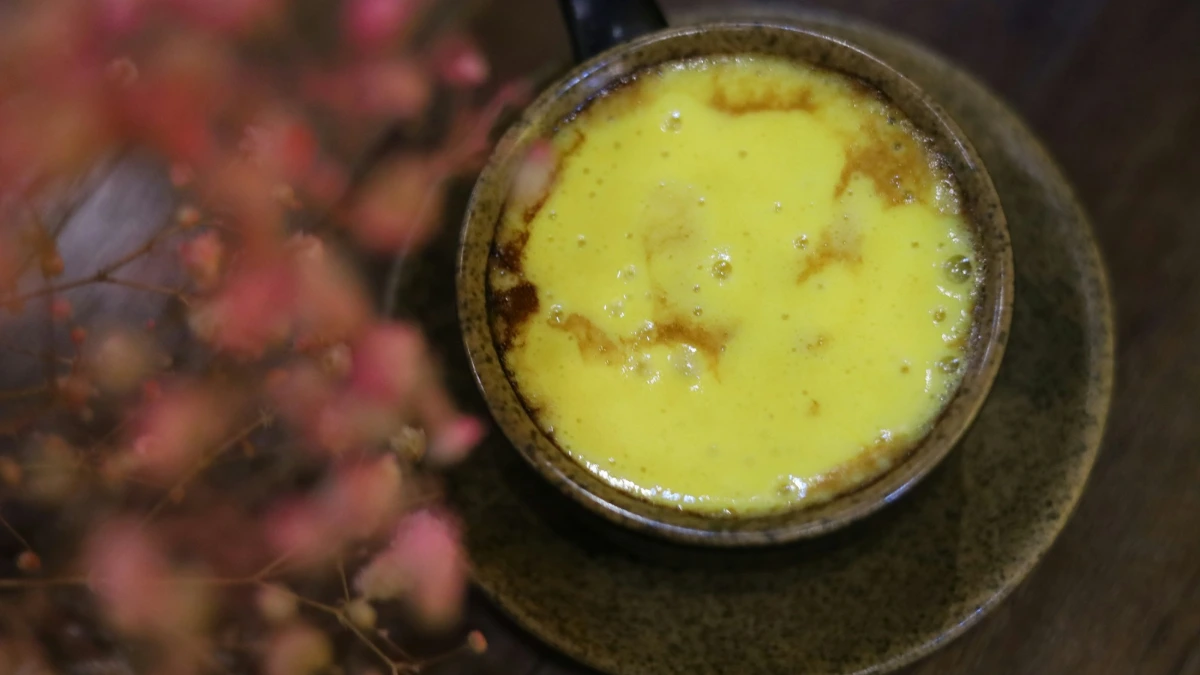
In 2026 a cup of egg coffee in Hanoi costs about 35,000–60,000 VND (roughly US$1.30–2.30) at most cafés. Prices are a little higher at rooftop or lake-view cafés. The figures below are typical ranges, not official prices, and can change.
| Where | Hot egg coffee (about) | Notes |
|---|---|---|
| Café Giảng (39 Nguyễn Hữu Huân) | 35,000–45,000 VND (US$1.30–1.70) | The original; egg cocoa and other variations at similar prices |
| Café Đinh (13 Đinh Tiên Hoàng) | 30,000–50,000 VND (US$1.15–1.90) | Same family recipe, lake views from a few seats |
| Café Phố Cổ (11 Hàng Gai) | 40,000–70,000 VND (US$1.50–2.70) | You pay a little extra for the rooftop lake view |
| The Note Coffee (64 Lương Văn Can) | 35,000–60,000 VND (US$1.30–2.30) | Busy, colourful, several floors |
| Loading T (8 Chân Cầm) | 35,000–55,000 VND (US$1.30–2.10) | Quiet colonial-house setting, daytime only |
| Ordinary Old Quarter cafés | 30,000–50,000 VND (US$1.15–1.90) | Quality varies; look for thick, pale foam |
Most cafés take cash, and many also accept Vietnamese QR payments; international cards are less common in small family cafés, so carry some small notes. Tipping is not expected.
How to Order and Drink Egg Coffee
Simply ask for “cà phê trứng” – add “nóng” for hot or “đá” for iced. At most cafés you order at the counter or from a staff member, then pay when you leave (or when ordering at busier places).
- Hot or iced: hot egg coffee shows off the foam best and is the classic choice; iced egg coffee is refreshing on a hot summer day but the foam melts faster.
- The bowl of hot water: if your glass arrives standing in a bowl of hot water, leave it there – it keeps the drink warm. Do not drink the water.
- Eat, then stir: many people eat a few spoonfuls of foam on its own first, like a dessert, then stir the rest into the coffee so the two layers blend.
- Less sweet: egg coffee is sweet by nature. You can ask for “ít ngọt” (less sweet), though the foam itself always contains sugar.
- Drink it fairly soon: the foam is at its best in the first 10–15 minutes, before it cools and separates.
- Caffeine: robusta is strong. If you are sensitive to caffeine, try egg cocoa instead.
Other Hanoi Coffee Drinks to Try
Hanoi has a whole coffee culture beyond egg coffee. Most drinks are based on robusta brewed in a phin and sweetened with condensed milk.
| Drink | What it is | Good to know |
|---|---|---|
| Cà phê nâu đá / cà phê sữa đá | Iced coffee with sweetened condensed milk | “Nâu” (brown) is the Hanoi name; “sữa đá” is the southern name. The everyday Vietnamese coffee |
| Cà phê đen (đá or nóng) | Black coffee, iced or hot | Strong and bitter; usually sweetened unless you ask for “không đường” (no sugar) |
| Cà phê cốt dừa (coconut coffee) | Coffee blended with coconut cream, condensed milk and ice into a slush | Popularised in Hanoi by the Cộng Cà Phê chain; a great summer drink |
| Cà phê muối (salt coffee) | Coffee with condensed milk topped with lightly salted cream | Created in Hue around 2010 and now sold in Hanoi too |
| Bạc xỉu | Lots of milk and condensed milk with a little coffee | Originally from Saigon’s Chinese-Vietnamese community; a mild choice |
| Sữa chua cà phê (yoghurt coffee) | Vietnamese yoghurt with a shot of coffee, often with ice | Tangy, refreshing and a Hanoi favourite |
| Cacao trứng (egg cocoa) | Hot cocoa topped with egg foam | Caffeine-free alternative to egg coffee |
For the dishes to pair with your coffee, see our guide to Hanoi food and drinks.

Best Time to Drink Egg Coffee in Hanoi
The best time for hot egg coffee in Hanoi is from October to March, when the city is cool and often grey and drizzly; in the hot months from May to September, iced egg coffee or coconut coffee is more refreshing. During the day, mornings and weekday afternoons are the quietest at the famous cafés.
| When | What to expect | Best choice |
|---|---|---|
| October – November (autumn) | Mild, dry, pleasant days and cooler evenings | Hot egg coffee on a lake-view balcony |
| December – February (winter) | Cool to cold (sometimes around 10–15°C), often grey | Hot egg coffee in a bowl of hot water – peak season |
| March – April (spring) | Mild, humid, sometimes drizzly | Hot or iced |
| May – September (summer) | Hot and humid with heavy showers | Iced egg coffee, coconut coffee or yoghurt coffee |
| Morning (07:00–10:00) | Locals’ coffee time; famous cafés are calmer | Good for photos and a seat by the window |
| Afternoon and weekend evenings | Busiest time at Café Giảng and lake-view cafés | Expect to share tables or wait a few minutes |
| Tết (Lunar New Year) | Many family cafés close for several days | Check opening days before you go |
Local Expert Tips for Hanoi Egg Coffee
These tips come from years of arranging Hanoi tours for international travellers.
- Have it as an afternoon break, not with breakfast: egg coffee is rich and filling – it works best as a mid-afternoon pick-me-up between sights.
- Go to the original first: Café Giảng is the reference point; once you know its taste, you can judge other cafés’ versions.
- Look for the alley: both Café Giảng and Café Phố Cổ are entered through narrow passages – travellers often walk past them. Follow the Google Maps pin closely.
- Watch the stairs: Café Đinh, Café Phố Cổ and Loading T are upstairs, up steep and narrow staircases that are not suitable for wheelchairs or pushchairs.
- Share if you are unsure: if you are not sure you will like it, order one egg coffee and one egg cocoa to share and taste both.
- Pace your caffeine: Vietnamese robusta is much stronger than most Western coffee; do not plan more than two or three coffees on a café crawl.
- Keep small notes: family cafés prefer cash; 50,000 and 100,000 VND notes are easiest.
- Combine it with a walk: egg coffee fits neatly into a loop around Hoan Kiem Lake and the Old Quarter streets.
- Bring it home: Vietnamese robusta beans, phin filters and condensed milk are easy to buy in Hanoi markets and shops, so you can make egg coffee at home.
Café Giảng vs Café Đinh
Both cafés belong to the same family and serve the original-style recipe, so the choice is mostly about setting.
| Café Giảng | Café Đinh | |
|---|---|---|
| Address | 39 Nguyễn Hữu Huân, down an alley | 2nd floor, 13 Đinh Tiên Hoàng, up a staircase |
| Connection | Founded by egg coffee’s inventor, Nguyễn Văn Giảng, in 1946 | Opened by Giảng’s daughter |
| Setting | Busy, simple, unpretentious café | Small, old-fashioned room; some seats overlook Hoan Kiem Lake |
| Serving style | Hot egg coffee usually in a bowl of hot water | Usually served in a small cup |
| Typical price | About 35,000–45,000 VND | About 30,000–50,000 VND |
| Crowds | Very popular, especially afternoons and weekends | Fewer seats, can fill up quickly |
| Best for | Tasting egg coffee where it began | A quieter cup with a lake view |
Our view: if you only have time for one, go to Café Giảng – it is the original, and the hot-water-bowl presentation is the classic Hanoi experience. If you prefer a calmer room and a glimpse of the lake, choose Café Đinh; with more time, try both on the same afternoon, as they are only a few minutes’ walk apart.
Nearby Attractions
All the classic egg coffee cafés are in or next to the Old Quarter, so it is easy to fit a cup in between sights:
- Hoan Kiem Lake – the heart of Hanoi, a minute or two from Café Đinh and a short walk from Café Giảng.
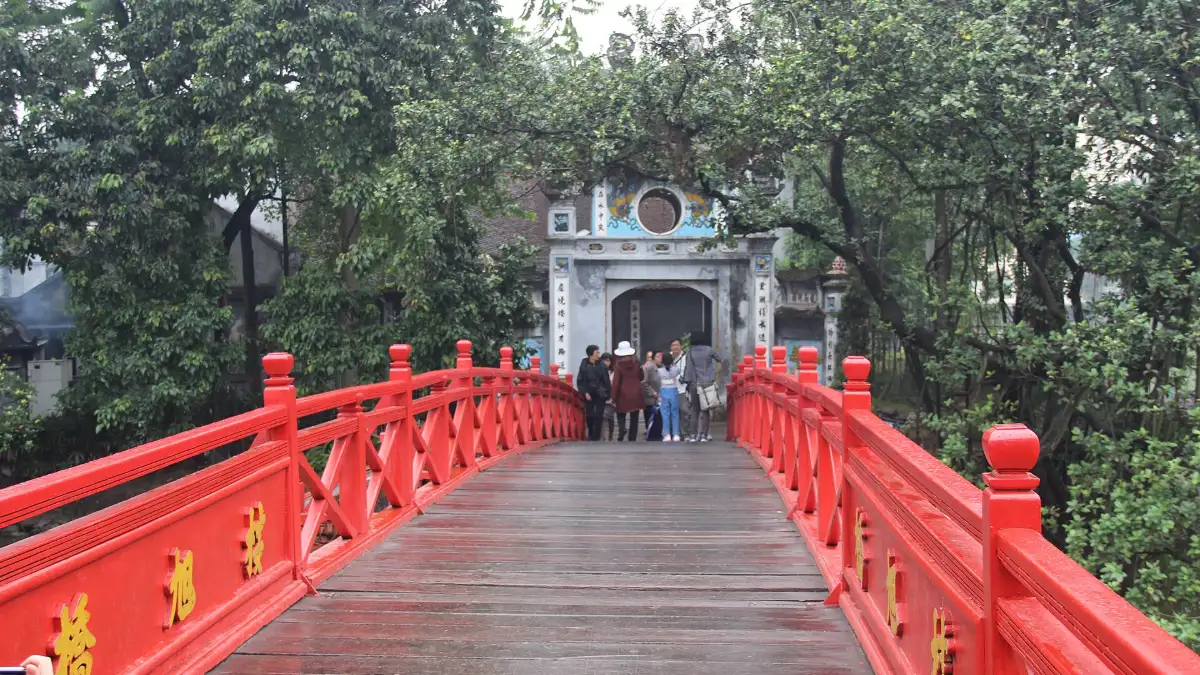
- Ngoc Son Temple – the temple on a small island in the lake, reached by the red Huc Bridge.
- Hanoi Old Quarter – the maze of “36 streets” where most egg coffee cafés are found.
- Dong Xuan Market – Hanoi’s largest covered market, at the northern edge of the Old Quarter.
- St Joseph’s Cathedral – the neo-Gothic cathedral beside Loading T and many cafés on Nha Tho Street.
- Hanoi Train Street – trackside cafés west of the Old Quarter; check the current rules before you go.
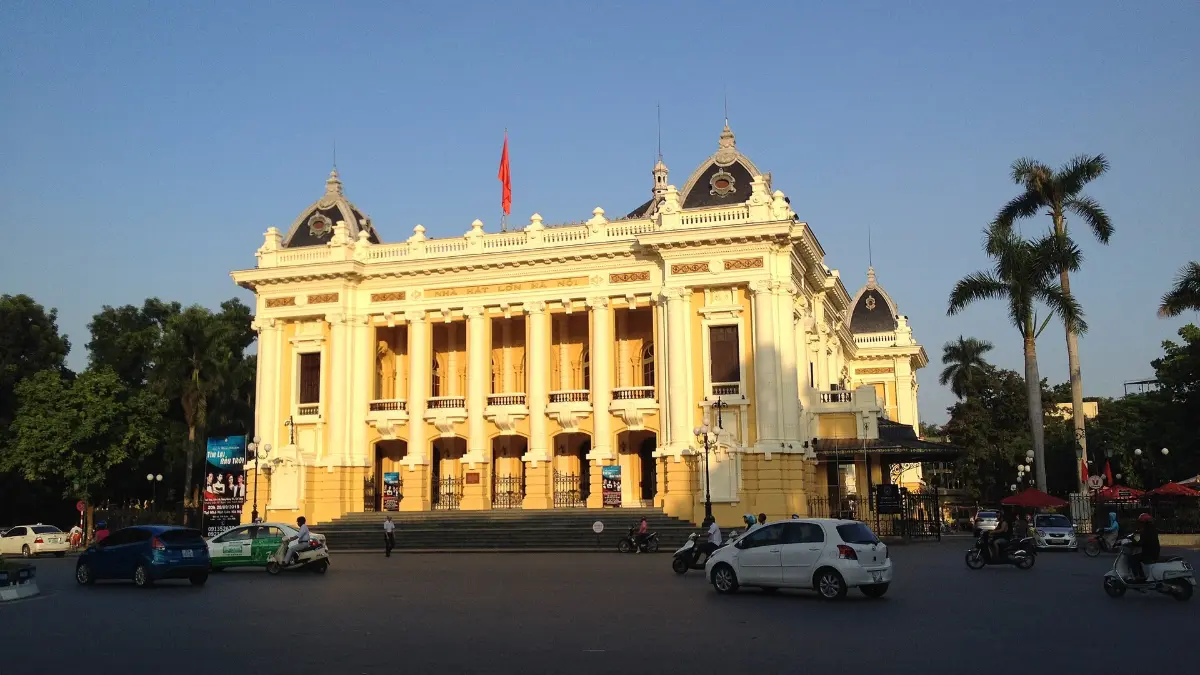
- Hanoi Opera House – the French-colonial landmark near the Metropole Hotel, where egg coffee’s story began (under renovation in 2026).
- Hoa Lo Prison Museum – the former French prison, about 15 minutes’ walk south of the lake.
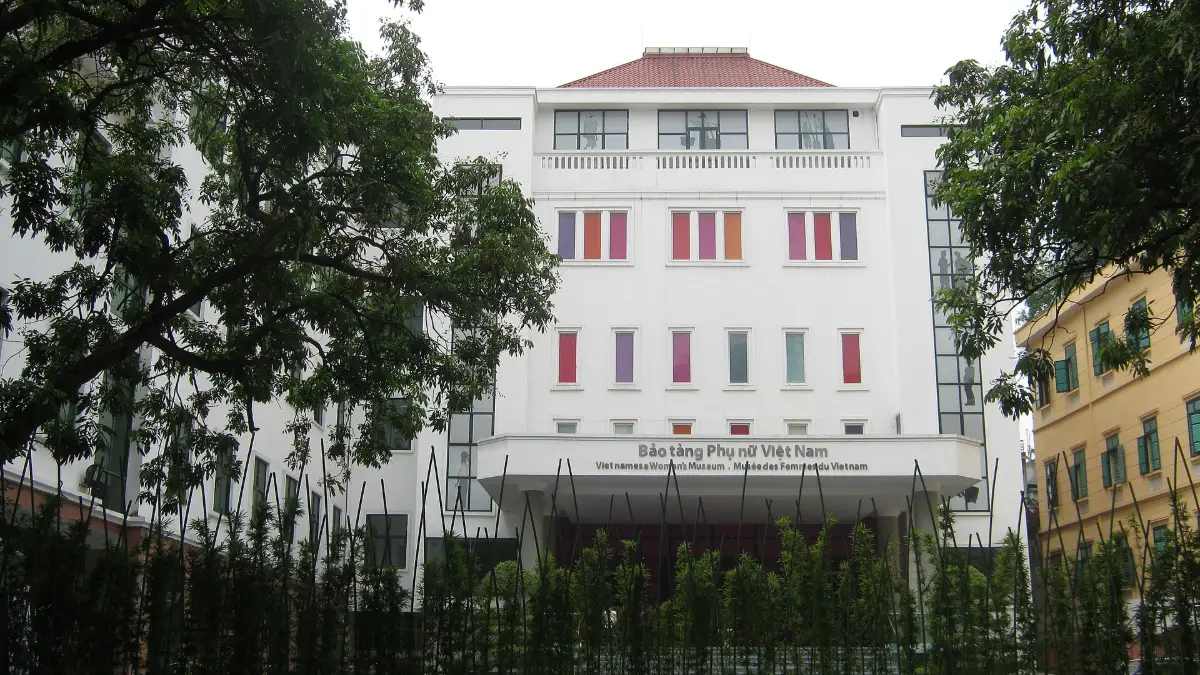
- Vietnamese Women’s Museum – an excellent small museum a few streets south of the lake.
Sightseeing in Hanoi for First-Time Visitors: Where Egg Coffee Fits
Egg coffee is best treated as a break inside a day of sightseeing rather than a sight in itself. A classic first day might start early at Ho Chi Minh Mausoleum (closed for maintenance from 4 September to 2 November 2026) and the Temple of Literature, continue with lunch in the Old Quarter, then a walk round Hoan Kiem Lake and an egg coffee at Café Giảng or Café Đinh in the afternoon. On a second day you could visit the Imperial Citadel of Thang Long and West Lake, stopping at the Yên Phụ branch of Café Giảng on the way.
For practical planning, read our Hanoi travel tips, how to get around in our Hanoi transportation guide, and where to buy coffee beans and phin filters in our Hanoi shopping guide. Plan your trip with our Hanoi travel guide and browse our Hanoi tours. Contact Vietnam Tour Expert Team for a free custom itinerary.
Frequently Asked Questions about Hanoi Egg Coffee
1. What is Hanoi egg coffee?
Hanoi egg coffee (cà phê trứng) is strong Vietnamese coffee topped with a thick foam of egg yolk whisked with sugar and sweetened condensed milk. It tastes sweet, creamy and custard-like, a little like a liquid tiramisu.
2. Who invented egg coffee in Hanoi?
Egg coffee was invented in the 1940s by Nguyễn Văn Giảng, a bartender at Hanoi’s Metropole Hotel, who used whisked egg yolk because fresh milk was scarce. He opened Café Giảng in 1946, and his family still runs it.
3. Where is the original egg coffee café in Hanoi?
The original egg coffee café is Café Giảng at 39 Nguyễn Hữu Huân Street in the Old Quarter (Hoan Kiem ward), down a narrow alley a short walk from Hoan Kiem Lake.
4. How much does egg coffee cost in Hanoi?
Egg coffee in Hanoi usually costs about 35,000–60,000 VND (roughly US$1.30–2.30) a cup in 2026. Lake-view rooftop cafés charge a little more.
5. What is the best egg coffee in Hanoi?
Café Giảng, the original, and Café Đinh, run by the same family, are the most famous places for egg coffee in Hanoi. Café Phố Cổ, The Note Coffee and Loading T are also popular for their settings.
6. Does Hanoi egg coffee taste like eggs?
Well-made egg coffee should not taste of raw egg; the yolk is whisked with sugar and condensed milk until it tastes like sweet custard or vanilla cream. A strong eggy smell usually means the foam was not whisked enough.
7. Is egg coffee in Hanoi safe to drink?
Egg coffee is widely drunk in Hanoi, but the yolk is whipped rather than fully cooked. Pregnant travellers, young children, people with weakened immunity and anyone allergic to eggs should avoid it; choose egg-free coffees instead.
8. Is egg coffee served hot or iced in Hanoi?
Egg coffee in Hanoi comes both hot and iced. Hot egg coffee is often served in a small bowl of hot water to keep it warm, while iced egg coffee is popular in summer.
9. Why is egg coffee served in a bowl of hot water?
The bowl of hot water keeps hot egg coffee warm while you slowly eat the foam and sip the coffee, which matters in Hanoi’s cool winter months. Leave the glass in the bowl and do not drink the water.
10. How do you drink egg coffee properly?
Most people eat a few spoonfuls of the egg coffee foam first, then stir the rest into the coffee underneath. Drink it within about 10–15 minutes, while the foam is still thick.
11. Is there a vegan or egg-free alternative to egg coffee in Hanoi?
There is no true vegan egg coffee at the classic cafés, because the foam is made of egg yolk and condensed milk. Vegans can order black coffee (cà phê đen) or ask about plant-based versions of coconut coffee, which normally contains condensed milk.
12. How much caffeine is in Hanoi egg coffee?
Egg coffee is made with Vietnamese robusta, which contains noticeably more caffeine than arabica, although the portion of coffee is small. If you are sensitive to caffeine, order egg cocoa instead.
13. What is the best time of year to drink egg coffee in Hanoi?
The best season for hot egg coffee in Hanoi is October to March, when the weather is cool. In the hot, humid months from May to September, iced egg coffee is more refreshing.
14. What other drinks are made with egg foam in Hanoi?
Besides egg coffee, Hanoi cafés serve egg cocoa, egg matcha and egg with green bean, all topped with the same whisked egg foam. Café Giảng offers several of these variations.
15. Can I make Hanoi egg coffee at home?
Yes. Whisk one egg yolk with 1–2 teaspoons of sugar and 1–2 tablespoons of condensed milk until thick and pale, then spoon it over a small cup of strong coffee – ideally Vietnamese robusta brewed in a phin.
16. Is egg coffee the same as salt coffee?
No. Egg coffee is from Hanoi and uses an egg-yolk foam, while salt coffee (cà phê muối) was created in Hue around 2010 and uses lightly salted cream. You can find both in Hanoi; see our Hue food guide for its home city.
17. How long should I spend at an egg coffee café in Hanoi?
About 30–45 minutes is enough to enjoy a cup of egg coffee and the atmosphere. Most travellers combine it with a walk around the Old Quarter.
18. Do egg coffee cafés in Hanoi accept cards?
Small family egg coffee cafés mostly prefer cash, and many accept Vietnamese QR payments. International cards are less widely accepted, so carry small VND notes; our Hanoi travel tips cover money and payments.
Related Posts

Hanoi Train Street (2026): Is It Open? Train Times, Cafés & Rules
Hanoi Shopping Guide: Best Markets, Streets & Souvenirs to Buy (2026)

Hanoi Travel Tips: Essential Things to Know Before You Go (2026)

Hanoi Transportation: How to Get Around Hanoi & From Noi Bai Airport (2026 Guide)
Hanoi Food & Drinks: 15 Must-Try Dishes, Egg Coffee & Where to Eat (2026)