Dau Go Cave: Halong Bay’s Historic Wooden Stakes Cave
 By Jimmy Nguyen, Founder & Director of Asia Travel Expert Co., Ltd.
Dau Go Cave (Hang Đầu Gỗ, “Cave of Wooden Stakes”) is a large cave on Dau Go Island in Halong Bay, about 300 m from Thien Cung Cave and a short boat ride from Tuan Chau. The French called it the “Grotte des Merveilles”. It is linked to General Tran Hung Dao’s 1288 Bach Dang victory and visited on route VHL1, included in the 250,000 VND route fee.
Status (checked October 2026): open daily as normal for boats on routes VHL1 and VHL5 (adult route fee 250,000 VND, plus port fee). Visits stop only when storms close the bay to boats, mainly between June and October.
Why Dau Go Cave is worth seeing:
- History in stone: legend says Tran Hung Dao stored the wooden stakes for the Battle of Bach Dang here.
- Royal and presidential visits: Emperor Khai Dinh in 1918 and President Ho Chi Minh in 1957.
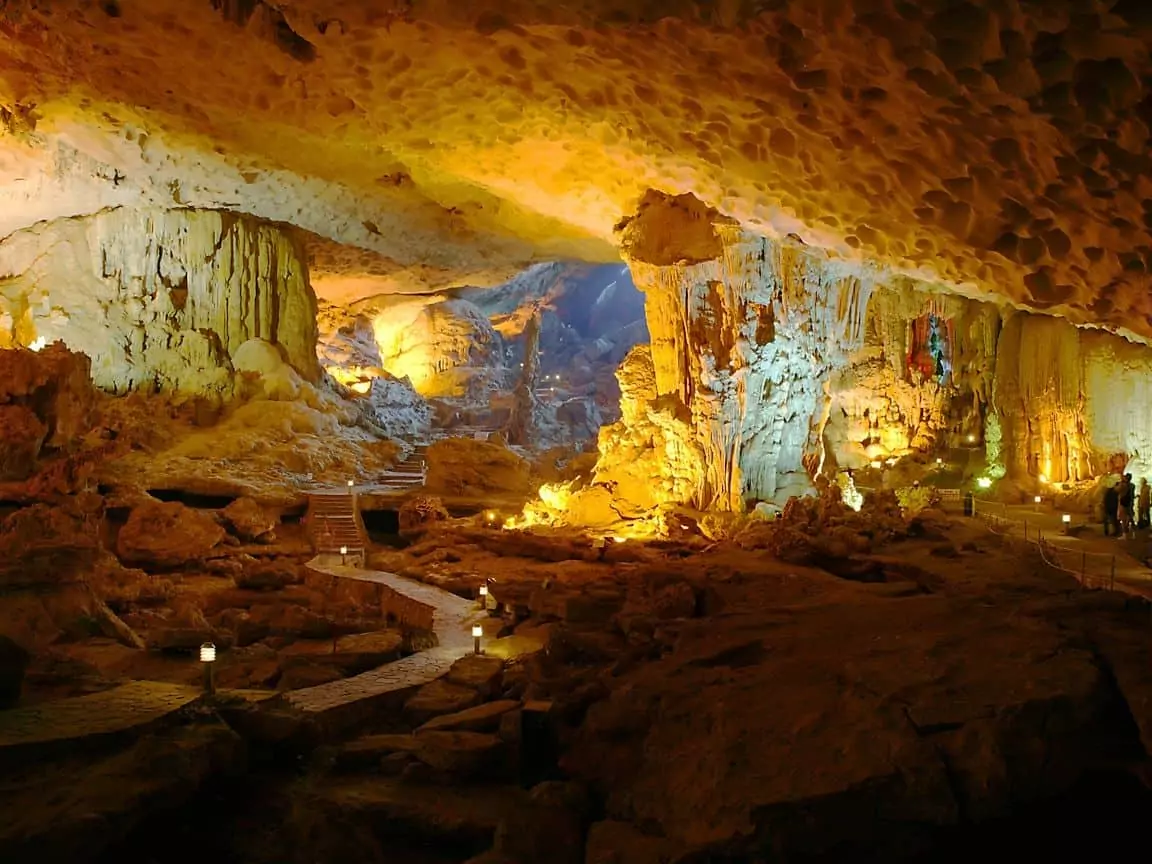
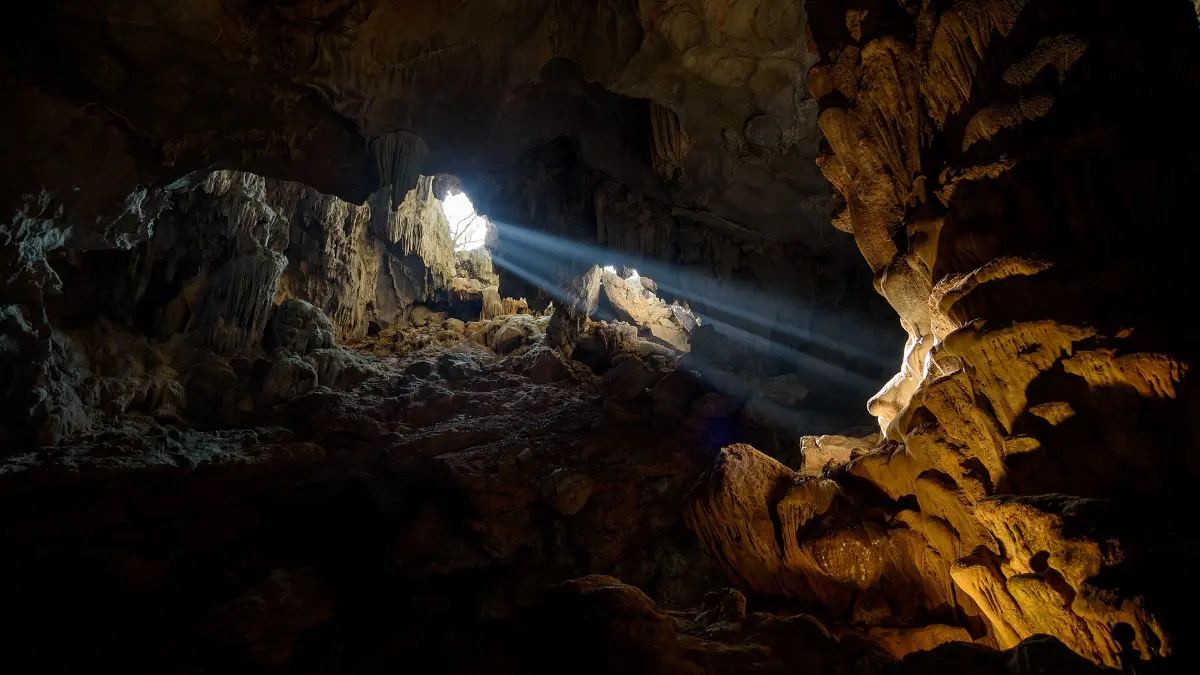
- The “Cave of Wonders”: a wide entrance, natural light and moss-green formations.
- Two caves in one stop: Thien Cung Cave is on the same island.
Dau Go Cave at a Glance
| Vietnamese name | Hang Đầu Gỗ (“Cave of Wooden Stakes”); French: Grotte des Merveilles |
|---|---|
| Location | Dau Go Island, south-west Halong Bay, Quang Ninh province |
| Distance | About 300 m from Thien Cung Cave; roughly 3 km from Tuan Chau port |
| Known for | The Bach Dang stakes legend, a Han-Nom poem stele of Emperor Khai Dinh, large chambers |
| Recognition | Part of the Ha Long Bay – Cat Ba Archipelago UNESCO World Heritage Site |
| Opening hours | Daily in daylight hours, when route VHL1 boats operate |
| Entrance fee | Included in the VHL1 route fee: 250,000 VND per adult (about US$10); children under 1.2 m free |
| Time needed | 30–40 minutes (1–1.5 hours with Thien Cung) |
| Best time | Early morning; March–May and September–November |
| Nearby | Thien Cung Cave, Fighting Cocks Islet, Incense Burner Islet, Dog Rock |
| Find it | Google Maps · Tripadvisor · UNESCO |
Is Dau Go Cave Worth Visiting?
Yes, as part of the same stop as Thien Cung Cave. Dau Go is less decorated than its neighbour but feels grander and more natural, and its stories link Halong Bay to some of the most famous moments in Vietnamese history. If you are taking a short VHL1 trip, you will see both caves in about an hour.
- Best for: history lovers, short trips from Ha Long and first-time visitors.
- Skip if: you have limited mobility; the entrance is reached by a stairway.
- Short on time: visit it with Thien Cung on a 4-hour VHL1 boat trip.
History of Dau Go Cave
The wooden stakes of Bach Dang
In 1288 General Tran Hung Dao defeated the Mongol-Yuan fleet on the Bach Dang River by driving wooden stakes into the riverbed. At high tide the stakes were hidden; as the tide fell, the enemy ships were impaled and trapped. Local tradition says the stakes were prepared and stored in this cave, which is how it got its name, “Đầu Gỗ” (heads of wood). The battle is well documented, but the cave’s role comes from legend rather than written records.
The “Grotte des Merveilles”
During the French colonial period the cave was known as the “Grotte des Merveilles” (Cave of Wonders), a name the Ha Long Bay Management Board still uses in English as the “Cave of Wonders”.
Royal and presidential visits
Emperor Khai Dinh visited in 1918 and had poems praising the bay and the cave composed; they were carved in Han-Nom characters on a stone stele that stands inside the cave. President Ho Chi Minh visited Dau Go Cave in 1957.
What to See at Dau Go Cave
1. The stairway and entrance
A stairway of roughly 90 steps climbs from the pier to the wide entrance, which lets natural light flood the first chamber.
2. The first chamber
The largest chamber has a high ceiling, around 25 m at its highest, and room for thousands of people. Stalactites and stalagmites here are covered with green moss.
3. The inner chambers
A narrower passage leads deeper inside, where stone pillars look like the ruins of an ancient palace carved by nature.
4. The Khai Dinh stele
Look for the stone stele bearing Emperor Khai Dinh’s Han-Nom poems, a reminder that the cave was admired long before modern tourism.
5. Views over the bay
From the entrance, the view takes in the channel towards Tuan Chau and the islands of route VHL1.
Dau Go Cave Tickets and Opening Hours (2026)
| Item | Details |
|---|---|
| Routes | VHL1 (with Thien Cung Cave and the islets); VHL5 towards Gia Luan |
| Adults | 250,000 VND route fee (about US$10), plus port fee |
| Children | Free under 1.2 m |
| Opening hours | Daily in daylight hours, when boats are permitted to sail |
| Combined route | VHL7 (VHL1 + VHL2 + VHL3 + VHL4): 600,000 VND |
Fees are set by Quang Ninh Province; see the Ha Long Bay Management Board website for updates.
Rules and Etiquette at Dau Go Cave
- Stay on the paths and do not touch or climb the formations.
- Do not write on or touch the stele.
- Take all rubbish back to the boat; single-use plastics are discouraged across Halong Bay.
How to Get to Dau Go Cave
| From | How | Time |
|---|---|---|
| Tuan Chau port | Tourist boat on route VHL1 | About 20–30 minutes |
| Ha Long International Passenger Port | Tourist boat | About 30 minutes |
| Thien Cung Cave | On foot | About 5 minutes (300 m) |
| Hanoi | Car or shuttle to Ha Long (2–2.5 hours), then boat | About 3 hours |
Transfers are covered in our Hanoi to Halong Bay guide.
Best Time to Visit Dau Go Cave
| When | What to expect |
|---|---|
| Early morning | Fewest people and soft light at the entrance |
| Late morning to early afternoon | Busiest with day boats |
| March – May, September – November | Comfortable for the climb |
| June – October | Hot; storms can stop boats |
| December – February | Cool and misty |
Local Expert Tips for Dau Go Cave
These tips come from years of arranging Halong Bay tours for international travellers.
- Visit Dau Go after Thien Cung: the open, natural light of Dau Go is a nice contrast.
- Ask your guide to show you the Khai Dinh stele; it is easy to miss.
- Read up on the Bach Dang battles before you go; the Quang Ninh Museum in Ha Long has a good gallery on them.
- Wear shoes with grip and bring water.
- More advice is in our Halong Bay travel tips.
Dau Go Cave vs Sung Sot Cave
| Feature | Dau Go Cave | Sung Sot Cave |
|---|---|---|
| Route | VHL1 | VHL2 |
| Highlight | History: Bach Dang legend, Khai Dinh stele | Size: about 10,000 m² in two chambers |
| Distance from Tuan Chau | About 3 km | About 14 km |
| Trip length | 4-hour boat trip possible | 5–6 hours on the water |
Our view: choose Sung Sot for sheer scale; choose Dau Go and Thien Cung when time is short or history interests you most.
Nearby Attractions
- Thien Cung Cave: the ornate “Heavenly Palace” next door.
- Halong Bay: Fighting Cocks and Incense Burner islets on route VHL1.
- Ti Top Island: the classic viewpoint on route VHL2.
- Luon Cave: kayaking into a hidden lagoon.
- Cua Van Fishing Village: fishing heritage on route VHL3.
Sightseeing in Halong Bay for First-Time Visitors: Where Dau Go Cave Fits
Short on time? Combine Dau Go and Thien Cung on a VHL1 trip, then spend the evening in Ha Long City. With a night to spare, an overnight cruise covers Sung Sot Cave and kayaking; see our cruise guide and Halong food guide.
Plan your trip with our Halong Bay travel guide and Halong Bay tours. Contact Vietnam Tour Expert Team for a free custom itinerary.
Frequently Asked Questions about Dau Go Cave
1. Where is Dau Go Cave?
Dau Go Cave is on Dau Go Island in south-west Halong Bay, about 300 m from Thien Cung Cave.
2. What does Dau Go Cave mean?
Dau Go means “heads of wood”, after the wooden stakes said to have been stored there for the Battle of Bach Dang.
3. What is the history of Dau Go Cave?
Dau Go Cave is linked by legend to Tran Hung Dao’s 1288 victory and was visited by Emperor Khai Dinh in 1918 and Ho Chi Minh in 1957.
4. Why did the French call Dau Go Cave the Grotte des Merveilles?
The French named Dau Go Cave the “Cave of Wonders” for its large chambers and formations.
5. How much is the Dau Go Cave ticket?
Dau Go Cave is included in the VHL1 route fee of 250,000 VND per adult, plus a port fee.
6. Which route includes Dau Go Cave?
Dau Go Cave is on route VHL1 (and VHL5), with Thien Cung Cave and the Fighting Cocks Islet.
7. How long does it take to visit Dau Go Cave?
About 30–40 minutes for Dau Go Cave, or 1–1.5 hours with Thien Cung.
8. How many steps are there at Dau Go Cave?
Roughly 90 steps lead from the pier up to the entrance of Dau Go Cave.
9. Is there a stele in Dau Go Cave?
Yes, Dau Go Cave has a stone stele with Han-Nom poems by Emperor Khai Dinh, who visited in 1918.
10. Did Ho Chi Minh visit Dau Go Cave?
Yes, President Ho Chi Minh visited Dau Go Cave in 1957.
11. Are Dau Go Cave and Thien Cung Cave on the same island?
Yes, Dau Go Cave and Thien Cung Cave are both on Dau Go Island, a short walk apart.
12. Is Dau Go Cave worth visiting?
Yes, Dau Go Cave adds history and natural light to a VHL1 trip and takes little extra time.
13. Is Dau Go Cave suitable for children?
Yes, most children manage Dau Go Cave; hold small children’s hands on the steps.
14. Can I visit Dau Go Cave on a day trip from Hanoi?
Yes, a Hanoi day trip with a VHL1 boat includes Dau Go Cave; see our transport guide.
15. What is the best time to visit Dau Go Cave?
Early morning is quietest at Dau Go Cave; spring and autumn have the best weather.
Related Posts
Ha Long City Guide 2026: Top Things to Do Beyond the Bay

Halong Bay Travel Tips 2026: Essential Things to Know Before You Go

Halong Food Guide: Squid Cake, Seafood & Where to Eat

Hanoi to Halong Bay 2026: Bus, Shuttle, Private Car & Times

Halong Bay Cruise Guide 2026: How to Choose the Best Cruise